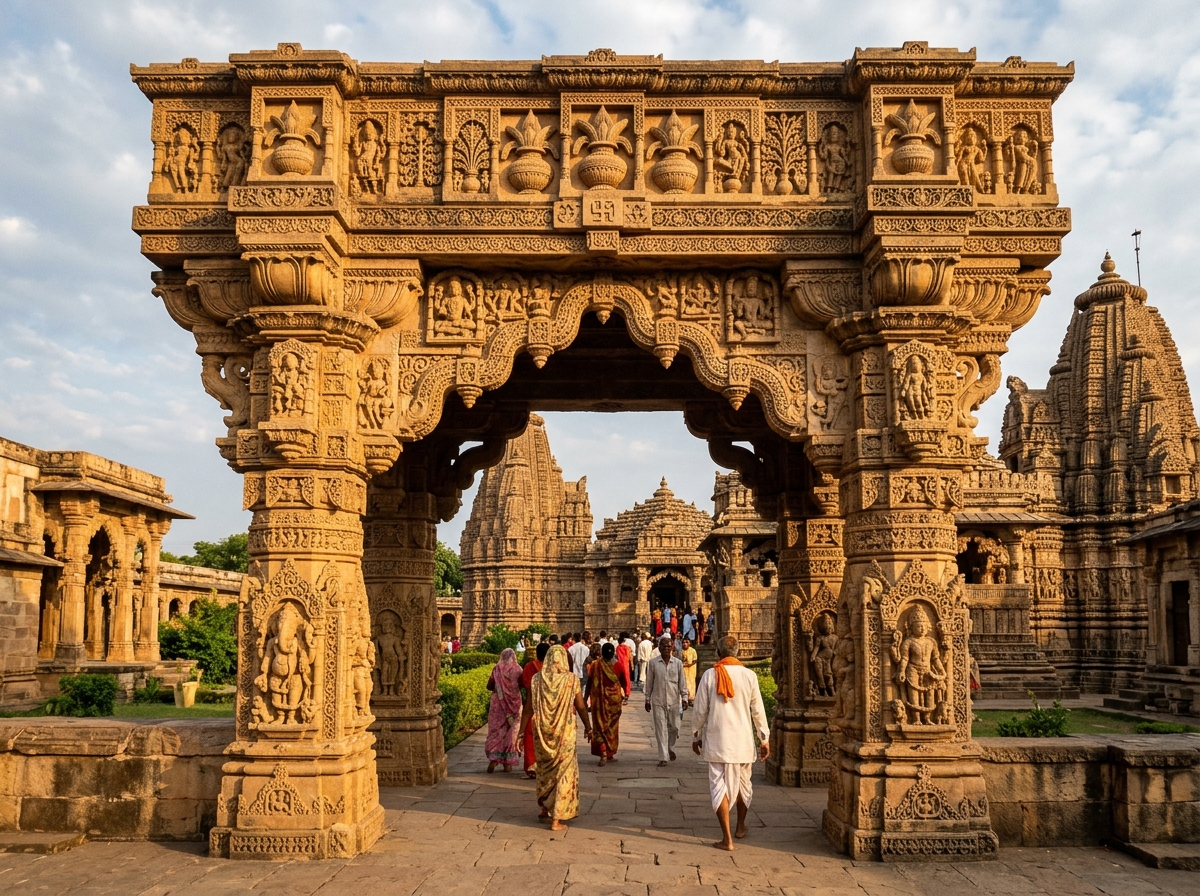
Temple trust governance in Bihar rests on a simple idea: a temple that serves the public should not be run as one person's private property. Public temples, monasteries (called mutts) and trusts are meant to be registered with a state board, they must report their land, and their money should be counted and recorded in a way others can check. This guide explains how that works, using two real Bihar examples as models of what a legitimate setup looks like.
It is general information, not legal advice. We describe only what public sources show, and we say where a detail could not be confirmed.
Key takeaways
- Under the Bihar Hindu Religious Trusts Act, 1950, public temples, mutts, trusts and dharamshalas must register with the Bihar State Board of Religious Trusts (BSBRT).
- Mahavir Mandir in Patna is run by a committee called Shri Mahavir Mandir Nyas Samiti, which reports its own donation totals and counting rules.
- The Mahabodhi Temple at Bodh Gaya is run by a different kind of body: a committee created by a state law, the Bodh Gaya Temple Act, 1949.
- A trustworthy trust has a named governing body, written rules, registered land, counted and recorded donations, and public reporting.
- No trust, trustee list or registration has been reported for the proposed Modi Mandir in Patna, so this article does not describe one.
How do temple trusts work in India?
A trust is a legal arrangement. One group of people (the trustees) holds property or money and must use it for a stated purpose, such as running a temple or a hospital. The trustees do not own the property for themselves. They hold it for the purpose.
There are two broad kinds. A private trust serves a family or a small group. A public trust serves the general public, and a public temple usually falls in this group. Because the public gives money and trust to a public temple, the state has laws that watch over such places. In Bihar the main law for Hindu temples is the Bihar Hindu Religious Trusts Act, 1950. Some very large or special temples are run under their own laws instead. Bodh Gaya is one of these.
Rules differ from state to state and from temple to temple. The sections below show the Bihar picture through two examples. For the wider legal question of public money and religion, see our explainer on Article 27 and state funding of temples.
What does the Bihar State Board of Religious Trusts do?
The Bihar State Board of Religious Trusts, or BSBRT, is the state body that keeps watch on Hindu religious trusts. Drishti IAS, in an article dated 9 August 2024 about a recent state government order, reports that the 1950 Act requires all public temples, mutts, trusts and dharamshalas to be registered with the BSBRT.
Drishti says the Bihar government told officials to make sure unregistered bodies register and to send the board the details of their immovable property (land and buildings). The government also said it would act against illegal property deals involving these institutions. Drishti reports these BSBRT figures:
| Group | Number | Land owned |
|---|---|---|
| Registered temples | About 2,499 | Over 18,456 acres |
| Unregistered temples and mutts | About 2,512 | About 4,321.64 acres |
These are numbers from one moment in 2024 and they change as more places register. They show why registration matters: land owned by religious bodies is large, and unregistered land is harder for anyone to track.
The board's work has had well-known leaders. Acharya Kishore Kunal, a retired police officer who also served as secretary of the Mahavir Mandir trust in Patna, later served as chairman of the BSBRT, according to Wikipedia's biography of him. He is also credited there with working to free temple property from illegal encroachment.
Example one: how is Mahavir Mandir in Patna run?
Mahavir Mandir is one of the best-known temples in Patna. Our Mahavir Mandir Patna visitor guide covers a visit. Here we look only at how it is run.
According to PTI, as published by Siasat on 7 July 2026, the managing body is named Shri Mahavir Mandir Nyas Samiti ("nyas" means trust, "samiti" means committee). The member secretary, Saayan Kunal, spoke to PTI for that report. Wikipedia says Acharya Kishore Kunal was secretary of the trust, that renovation started on 30 October 1983 and that the temple was inaugurated on 4 March 1985. He died on 29 December 2024.
Where does the money come from and go?
PTI quotes the trust saying that donations in the 2025-26 financial year came to Rs 5.93 crore, and that yearly donations are estimated at Rs 4 to Rs 6 crore. This is the trust's own statement. We did not find published audited accounts, so we cannot confirm the figure independently.
On the spending side, Wikipedia's biography of Kishore Kunal says the trust runs nine hospitals, including a cancer institute, a heart hospital and an eye hospital. We could not check that count against the trust's own pages, so treat it as unconfirmed. A PatnaPress report of 21 January 2024 says the trust paid Rs 10 crore in instalments towards the Ram temple in Ayodhya, starting with Rs 2 crore on 2 April 2020, with a last Rs 2 crore cheque handed over on the eve of the consecration. That report does not say where the money came from.
What checks are reported?
The PTI report lists several steps the committee says it now follows when donations are counted:
- Six CCTV cameras cover the counting room.
- Staff in the monitoring room stop unauthorised people from entering during counting.
- Cash is sorted, counted, packed and sealed in front of bank officials.
- Counting staff wear clothes without pockets, supplied by the temple.
- Donation boxes are opened in front of committee members.
- Offerings are reviewed every month, and a chartered accountant (a qualified accounts professional) has been appointed only for this review.
These steps are the kind of habit that makes a trust easy to trust: counting is done in public view, by more than one person, with a bank involved and a written record. They are described as the trust's own measures. We have not seen an outside inspection of them.
Example two: how is the Mahabodhi Temple at Bodh Gaya run?
Bodh Gaya is a different model. The Mahabodhi Temple is sacred to Buddhists and is also a UNESCO World Heritage Site (added in 2002, according to Drishti IAS). It is not run by a private trust. It is run by the Bodh Gaya Temple Management Committee (BTMC), which a state law, the Bodh Gaya Temple Act, 1949, created.
Wikipedia says that before the Act the temple was managed by the Mahant, a Hindu priestly authority. The Act set up a committee instead. Drishti IAS says the committee began work in 1953.
Who sits on the committee?
The committee's own website says it has nine members: four Buddhist members, four Hindu members and the District Magistrate of Gaya as chairperson. The Bihar government nominates the members, who serve three-year terms, and one member is the Member-Secretary. The website says the current term began on 26 July 2023. The committee usually meets every three to four months and sends the record of each meeting to the state's Home Secretary.
Reports differ on the size. Drishti IAS describes eight members, which seems to leave out the chairperson. We use the committee's own figure of nine. A 2013 amendment, noted on Wikipedia, removed the rule that the District Magistrate must be a Hindu.
Why is it in the news?
Drishti IAS reports that Buddhist monks led by the All India Buddhist Forum began protests in April 2025. They want the 1949 Act repealed (cancelled) and say Buddhists alone should manage the temple. We do not take a side here. We mention it because it shows a real point about governance: who sits on a managing body, and who chooses them, is often the most argued-over question.
Comparing the two models
| Question | Mahavir Mandir, Patna | Mahabodhi Temple, Bodh Gaya |
|---|---|---|
| Managing body | Shri Mahavir Mandir Nyas Samiti (a trust committee) | Bodh Gaya Temple Management Committee |
| Where its power comes from | A trust, in a state with the 1950 Act for Hindu religious trusts | The Bodh Gaya Temple Act, 1949 |
| Who picks the members | Not stated in the sources we found | The Bihar government nominates eight members; the District Magistrate of Gaya is chairperson |
| Public information | Counting rules and donation total shared through PTI | Member list, term dates and meeting habits on its website |
| Open questions | No audited accounts found | Dispute over who should manage the temple |
What does a legitimate temple trust look like?
From these examples and the Bihar rules, we can draw a simple checklist. This is our reading, not an official standard.
- A named body with named people. You can find who the members or trustees are and when their term began.
- Registration. A public temple or trust in Bihar should be registered with the BSBRT, and its land should be on record.
- Written rules. There is a trust deed or law that says what the money may be used for.
- Money handled by more than one person. Donations are counted openly, banked, and recorded.
- Regular accounts. Someone qualified checks the accounts, and the results can be asked for.
- A real, stated purpose. The trust says what it does, for example running a temple or a hospital, and then does it.
What about the proposed Modi Mandir in Patna?
We include this section only to be clear. The Bihar State Transgender Welfare Board approved a proposal to build a temple for Prime Minister Narendra Modi at its first meeting on 29 July 2026, according to PTI. Board member Rajan Singh (PTI spells the name Ranjan) proposed it. Later reports quote Singh saying the board asked the government for five acres and Rs 112 crore.
We found no report of a registered trust, a list of trustees, a trust deed, an allotted plot or sanctioned money for this temple. So there is nothing yet to compare with the checklist above. If a trust is formed, the things to look for are the ones listed in the previous section. For the money question see why reports on the cost disagree, and for the legal question see whether a temple can be built for a living person.
What we do not know yet
- How the BSBRT checks accounts. We found its registration role but no public description of its audit steps.
- Whether Mahavir Mandir publishes audited yearly accounts. We did not find them.
- How the Mahavir Mandir committee members are chosen.
- The exact number of hospitals linked to the Mahavir Mandir trust, which we saw only on Wikipedia.
- Whether any trust will be created for the Patna Modi Mandir proposal.
Common questions
Do all temples in Bihar have to register?
Under the Bihar Hindu Religious Trusts Act, 1950, public temples, mutts, trusts and dharamshalas must register with the BSBRT, according to Drishti IAS. Private family shrines are a different matter.
Who runs Mahavir Mandir in Patna?
A committee called Shri Mahavir Mandir Nyas Samiti, according to PTI. Saayan Kunal is named as its member secretary.
Who manages the Mahabodhi Temple at Bodh Gaya?
The Bodh Gaya Temple Management Committee, set up under the Bodh Gaya Temple Act, 1949. It has four Buddhist and four Hindu members, with the Gaya District Magistrate as chairperson.
Is there a trust for the proposed Modi Mandir?
No trust has been reported in the sources we found. The proposal was approved by the Bihar State Transgender Welfare Board on 29 July 2026, and reports say no land has been allotted.
Sources
- Drishti IAS: Bihar mandates registration of temples, mutts and trusts (9 August 2024)
- Drishti IAS: Bodhgaya Temple (April 2025)
- Bodhgaya Temple Management Committee: members, terms and duties
- Wikipedia: Bodh Gaya Temple Act
- Siasat / PTI: Security stepped up for counting of donations at Mahavir Temple (7 July 2026)
- PatnaPress: Mahavir Mandir Trust contributes Rs 10 crore to the Ayodhya temple (21 January 2024)
- Wikipedia: Kishore Kunal
More on money and law is on our law and money topic page, and quick answers are on the FAQs page.
Last checked on 24 October 2026. Spotted a mistake? Tell us through our contact page.