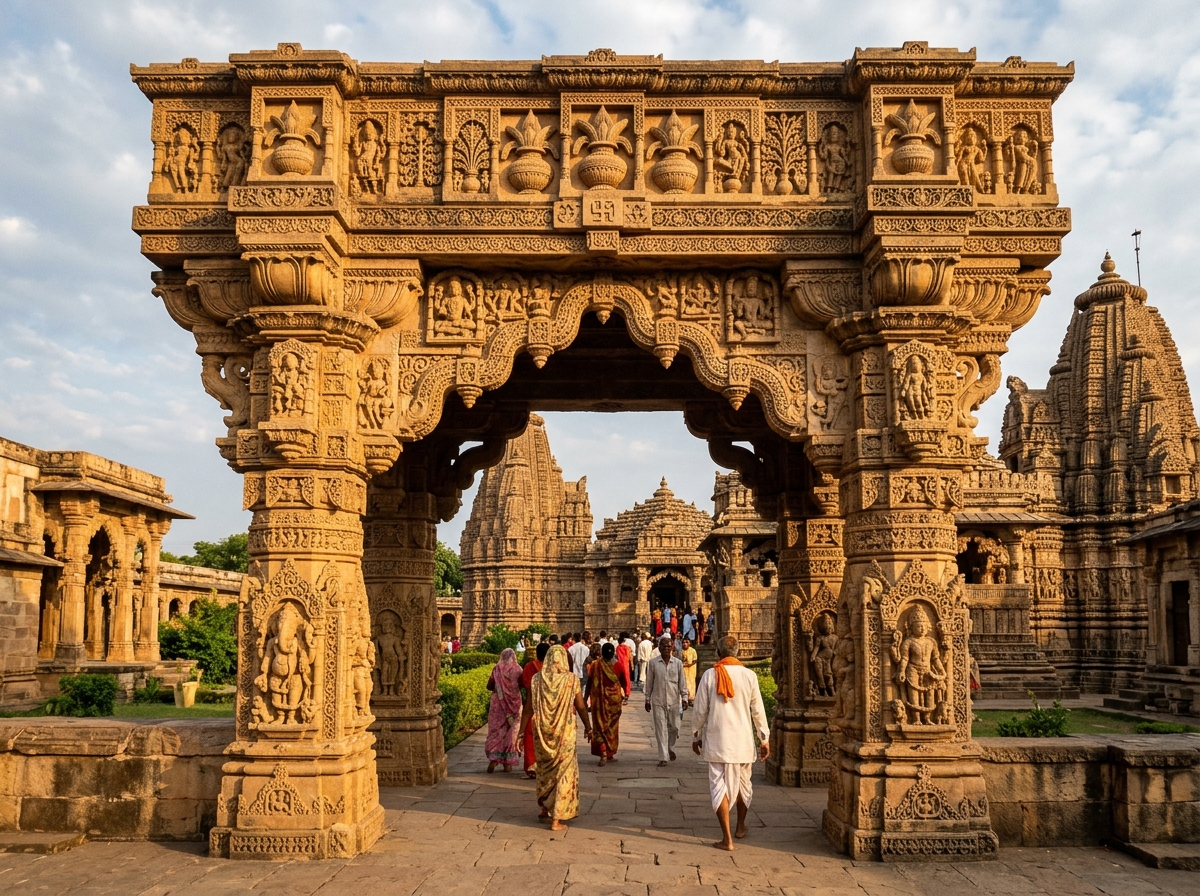
Article 27 of the Constitution of India says that no person can be forced to pay a tax if the money is set aside to promote or run a particular religion. That is the short answer to the question many readers ask about the Patna Modi Mandir proposal. But Article 27 is narrower than most people think, and the courts have read it with care. This page explains the text, three important Supreme Court cases, and what we can and cannot say about Patna.
This is general information, not legal advice. We are not lawyers giving an opinion on any real dispute.
Key takeaways
- Article 27 protects a taxpayer from being compelled to pay a tax whose proceeds are specifically set aside for promoting or maintaining a particular religion or religious denomination.
- The Supreme Court has said the article is about taxes that are earmarked, or in practice mostly used, for one religion. Small facilities or concessions do not break it.
- The three cases usually cited are Shirur Mutt (1954), Reghunath (1974) and Prafull Goradia (2011).
- For Patna, the only public figures (about 5 acres and ₹112 crore) come from board member Rajan Singh. No sanction, land or budget has been confirmed.
- No court has ruled on the Patna proposal, so nobody can say today how Article 27 would apply to it.
What does Article 27 of the Constitution say?
The heading of Article 27 is "Freedom as to payment of taxes for promotion of any particular religion". The text says: "No person shall be compelled to pay any taxes, the proceeds of which are specifically appropriated in payment of expenses for the promotion or maintenance of any particular religion or religious denomination." You can read the text on the Constitution of India reference page for Article 27. The Constituent Assembly debated it on 7 December 1948, when it was still draft Article 21, and adopted it without amendment that day.
Let us break the words down.
- Compelled to pay. A tax is a payment the law forces you to make. You cannot choose to skip it.
- Specifically appropriated. "Appropriated" means set aside. The money must be earmarked for a purpose.
- Particular religion or religious denomination. The word "particular" matters. The protection is about money used for one religion or group, not about spending on public services that everyone uses.
Article 27 sits with Articles 25, 26 and 28 in the Constitution's part on freedom of religion. Together they deal with freedom of religion and with how the state treats it.
What Article 27 does not say
People often read more into Article 27 than it holds. Here are some common mix-ups.
| Common belief | What the article and the cases show |
|---|---|
| The state can never spend any money near a religious site. | Article 27 is about taxes earmarked for a religion. The Supreme Court has said that small facilities or concessions to a group do not break it (Goradia, 2011). |
| Any government charge on a religious body is banned. | Not so. Explainers on Shirur Mutt say the Court looked at the purpose. A charge meant for proper administration of religious institutions did not breach Article 27. |
| The article stops private people from building temples. | It does not. It is about compelled taxes, not about what private citizens fund with their own money. |
| Article 27 bans any government spending that helps a religion. | Not as written. The Court in Goradia said a relatively small share of a tax used for facilities does not break it. Only a substantial share does. |
What did the Shirur Mutt case decide in 1954?
The full name is Commissioner, Hindu Religious Endowments, Madras v. Sri Lakshmindra Thirtha Swamiar of Sri Shirur Mutt. The Supreme Court decided it on 16 March 1954. It is reported as 1954 SCR 1005. A "mutt" is a Hindu religious institution led by a head, often a monk.
The case was about a Madras law, the Hindu Religious and Charitable Endowments Act, 1951. The law made religious institutions pay a contribution to the government to cover the cost of supervising them. The mutt argued that this was a tax and that it broke Article 27, among other rights.
According to the legal explainer on iPleaders, the Court held that the contribution was a tax and not a fee. It looked at features such as the payment depending on the institution's income, institutions earning under Rs 1,000 a year being exempt, and the money going into the government's general fund. The same explainer says the object of the law was the proper administration of religious institutions, so Article 27 was not violated.
The explainer on Vajiram and Ravi draws the same lesson: the purpose of the charge counts. A charge for managing religious bodies is different from a charge for promoting a religion.
Be careful here. The sources we found do not fully agree on every finding in this long judgment, and one search result described the Madras law's contribution clause as struck down for a different reason. We have not read the full judgment text, so if you need the exact holding, read the judgment itself.
What did the Reghunath case decide in 1974?
K. Reghunath v. State of Kerala (1974) came out of violence in Tellicherry (Thalassery), where places of worship were damaged. The Kerala government ordered that the state would pay to restore them, and it contributed to a Distress Relief Fund.
The iPleaders explainer says the Kerala government sanctioned Rs 10 lakh to a Distress Relief Fund, and the Supreme Court dismissed the challenge for two reasons. The Fund did not come from tax money, because it drew on contributions from many sources. And restoring damaged places of worship was not the same as promoting or maintaining a religion. We could not open the judgment text for this case, so we rely on that secondary summary and we do not give a reporter citation.
The 1974 case shows a simple point. Not every rupee that touches a place of worship is a tax earmarked for a religion.
What did the Prafull Goradia case decide in 2011?
Prafull Goradia v. Union of India, decided on 28 January 2011 by a bench of Justices Markandeya Katju and Gyan Sudha Misra, is the best-known modern Article 27 case (Governance Now). The petitioner, former MP Prafull Goradia, challenged the Haj subsidy. Reports differ on which Haj Committee Act was named. He argued that part of the taxes he paid went to a pilgrimage made only by Muslims, and that this broke Articles 14, 15 and 27.
The Court dismissed the petition. As summarised by SCC Online, which reported a later judgment that relied on Goradia, the Court said:
- The object of Article 27 is to maintain secularism.
- The article can apply even to a general tax law, not only one that names a religion, if a substantial part of the tax is in fact used for one religion.
- If only a relatively small part of a tax is used for conveniences, facilities or concessions for a religious group, that does not break Article 27.
The commentary on Law and Other Things adds that, in the Court's calculations, 25 percent of the income tax collected would be a substantial amount. That was an example, not a fixed rule. It also notes that the article's own words do not say "substantial part". That test is the Court's reading.
The three cases side by side
| Case | Year | The question | Result |
|---|---|---|---|
| Shirur Mutt | 1954 | Was a contribution charged to religious institutions a tax that broke Article 27? | The law aimed at proper administration, not at promoting a religion, so Article 27 was not attracted. |
| K. Reghunath v. State of Kerala | 1974 | Could the state fund repair of damaged places of worship? | Challenge dismissed. The money was not tax money and repair was not promotion of a religion. |
| Prafull Goradia v. Union of India | 2011 | Did the Haj subsidy use a taxpayer's money to promote one religion? | Petition dismissed. A small part of a tax used for facilities does not break Article 27. |
Notice what is common to all three. On Article 27, the Court rejected the challenge each time. The Court asked what the money was really for, how much of it there was, and whether it came from a tax at all. The article is real, but the tests make it hard to win a case under it.
How does this connect to the Patna Modi Mandir proposal?
Here is what is documented. On 29 July 2026, at its first meeting in Patna, the Bihar State Transgender Welfare Board approved a proposal to build a temple for Prime Minister Narendra Modi. Board member Rajan Singh made the proposal. The Free Press Journal reported that Singh said the state government would identify land and bear the construction cost, but it gave no amount. Drishti IAS reported the board's approval too, but it said nothing about funding, government sign-off or construction.
Later reports, including ETV Bharat and PatnaPress on 11 August, quoted Singh as saying the board had asked the government for about 5 acres of land and ₹112 crore, plus a life-size gold statue. Those figures come only from Singh. We have found no government order that confirms them. Our page on the ₹112 crore claim and our explainer on why reports on the cost disagree go through this in detail.
This is why we do not say how Article 27 applies. Article 27 is about a tax whose proceeds are earmarked for a religion. To say it applies, you would first need to know:
- whether any public money has actually been approved;
- where it would come from, and whether it is a tax earmarked for this purpose;
- how big the share is, set against the whole budget of the government;
- whether the temple counts as promoting "a particular religion" in the sense of Article 27.
None of these is confirmed. A court has not been asked, and nobody has filed a case on the temple that we could find. So any reader who tells you "this is clearly illegal" or "this is clearly fine" is going beyond the facts.
What we do not know yet
These points are unconfirmed as of 24 October 2026.
- Whether the state government has approved any land or money for the temple.
- Whether the ₹112 crore figure is a request, a plan for public money, or a plan for donations. It comes from Rajan Singh's own statements.
- Whether any trust or private body would own or run the temple.
- Whether anyone has gone to court about it.
- How a court would apply Article 27 if asked.
The question of whether a temple can be built for a living person at all is a separate matter. Our piece on building a temple for a living person covers it. On how temple money is usually managed, see our comparison of temple trust management in Bihar. For more on the legal and money side of the story, visit the law and money topic page, and our project timeline shows the dates.
Glossary
- Tax. A payment the law forces you to make to the government, with no direct service in return.
- Fee. A payment for a particular service you receive.
- Earmarked or appropriated. Set aside for one purpose.
- Religious denomination. A group within a religion with its own beliefs and name.
- Mutt. A Hindu religious institution led by a head.
- Petitioner. The person who brings a case to court.
Common questions
Does Article 27 stop the government from spending money on temples?
Not by itself. Article 27 is about taxes whose proceeds are earmarked for a particular religion. The Supreme Court has said that using a small part of a tax for facilities for a religious group does not break it.
Is the Patna Modi Mandir paid for by taxpayers?
Not confirmed. Rajan Singh has said the state would bear the cost, but no government order or budget has been published that we could find.
Has any court ruled on the Patna temple and Article 27?
No. We found no court case about the proposal, so no court has said how Article 27 applies to it.
Which cases explain Article 27?
The three usually cited are Shirur Mutt (1954), K. Reghunath v. State of Kerala (1974) and Prafull Goradia v. Union of India (2011).
Sources
- Constitution of India: Article 27 text and Constituent Assembly debate
- iPleaders: Article 27 of the Indian Constitution (Shirur Mutt, Reghunath, Goradia)
- SCC Online: report of a 2017 judgment relying on Prafull Goradia
- Governance Now: Haj, other pilgrimage subsidies not unconstitutional (28 January 2011)
- Law and Other Things: commentary on Goradia and Article 27
- Vajiram and Ravi: Article 27 explainer
- Free Press Journal: Bihar transgender welfare board approves temple for Modi (29 July 2026)
- Drishti IAS: Bihar board clears proposal for PM Modi temple (31 July 2026)
Last checked on 24 October 2026. Spotted a mistake? Tell us through our contact page.