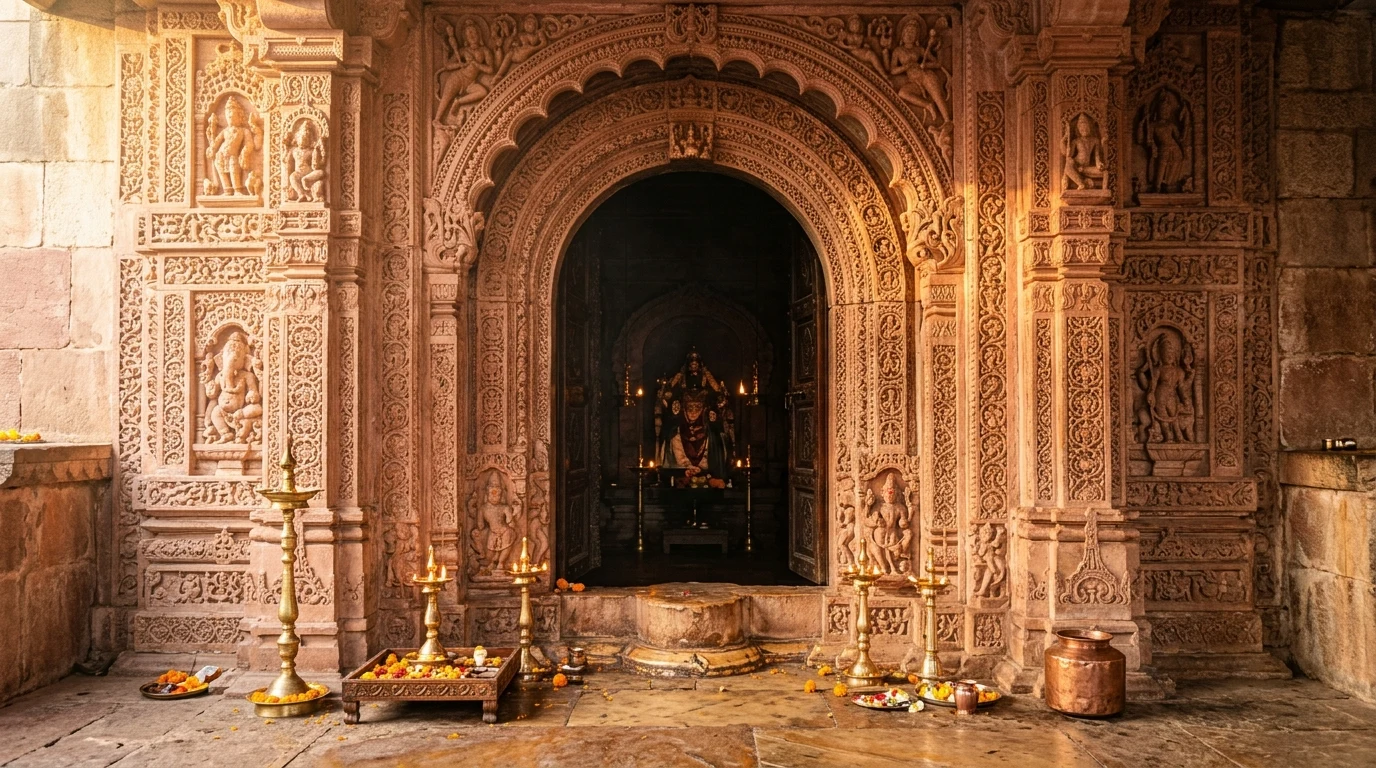
The Koovagam festival is an 18-day temple festival at the Koothandavar temple in Koovagam village, Tamil Nadu, where thousands of transgender women ritually marry the deity Aravan and mourn him as widows the next day. It is held every year in the Tamil month of Chithirai, which falls in April and May. In 2026 the wedding night was reported on 28 April and the mourning and chariot procession on 29 April.
This guide explains the Aravan story behind the festival, what happens on the main days, why the festival matters so much to the thirunangai community, and what the words aravani and thirunangai mean. We also cover the Tamil Nadu welfare board that set a pattern for the rest of India. Every fact is linked to a named source at the end.
Key takeaways
- Koovagam is a village in Ulundurpet taluk. Most reports still say Villupuram district, but since November 2019 this area has been part of the new Kallakurichi district.
- The temple's deity is Koothandavar, a local name for Aravan, a son of Arjuna in the Mahabharata.
- In the Tamil story, Aravan is sacrificed before the great war and asks to marry first. Krishna takes the female form of Mohini to marry him, then mourns him as a widow.
- Devotees re-enact this: priests tie a tali (wedding thread) for them one night, and the next day they cut it, break their bangles and wear white.
- Aravani is an older Tamil word for transgender women. Thirunangai, meaning roughly "respected woman", was adopted officially in 2006 and is the preferred term today.
- Tamil Nadu formed India's first transgender welfare board on 15 April 2008, according to the state's Social Welfare Department.
What is the Koovagam festival?
The festival takes its name from Koovagam, a small village in Ulundurpet taluk, about 25 km from Villupuram town according to Sahapedia. The temple there is dedicated to Koothandavar, who is identified with Aravan. The festival lasts about 18 days, which echoes the 18 days of the Kurukshetra war in the Mahabharata.
For most of those days it is a village temple festival with flag hoisting, daily rituals and storytelling. In the last few days the village fills up. Transgender women, known in Tamil as thirunangai, travel from across Tamil Nadu, other Indian states and abroad. Village men and families who have made vows to the deity also take part. DT Next reported in April 2026 that thousands of people dressed as brides, including members of the trans community, men and even children.
A note on the district. Older articles, Sahapedia and many news reports place Koovagam in Villupuram district. Kallakurichi district was carved out of Villupuram and inaugurated on 26 November 2019, according to the Kallakurichi district website, and ETV Bharat's 2026 report places the temple in Kallakurichi district. The village has not moved; the district boundary has. The pageants are still held in Villupuram town.
Who is Aravan, and why did Krishna marry him as Mohini?
Aravan is the Tamil name of Iravan, a son of the Pandava hero Arjuna and the Naga princess Ulupi. The story differs between the Sanskrit epic and the Tamil retellings, and it helps to keep the two apart.
- In the Sanskrit Mahabharata, Iravan is a minor warrior. He fights for the Pandavas and is killed on the eighth day of the war by the demon Alambusha.
- In the Tamil tradition, Aravan offers himself as a sacrifice to the goddess Kali before the war begins, so that the Pandavas will win. This pre-battle sacrifice is called kalappali, "the battlefield sacrifice". The earliest surviving Tamil account is usually traced to the Parata Venpa of Peruntevanar, which scholars date to around the 8th or 9th century. Sources differ on the exact century.
- The boons. In return for his sacrifice, Krishna grants Aravan wishes. The one at the heart of Koovagam is that Aravan does not want to die unmarried. To grant it, Krishna takes the form of Mohini, an enchanting female form of Vishnu, and marries him. After Aravan's death, Mohini grieves as his widow.
Another boon lets Aravan watch the whole war with his severed head. That is why the deity at Koovagam, and in other Tamil temples, is worshipped above all as a head.
The American scholar Alf Hiltebeitel studied this cult closely. In a 1995 paper in The Journal of Asian Studies, he described how the Koothandavar festival stages Aravan's repeated death and revival through icons, effigies and people. You can read the paper's opening on Cambridge Core.
Why do transgender women go to Koovagam?
For many thirunangai, the story of Mohini is their own story in sacred form. A divine being who was born male takes a woman's form, becomes a bride, and is honoured for it. By marrying Aravan, devotees step into Mohini's place. This is why Aravan is often called the patron deity of the thirunangai community.
People who attend describe several reasons for going:
- Faith. An attendee named Shanshi told the Associated Press in 2026 that Aravan is "God for all transgender people", and that the gathering is "to worship Lord Aravan by getting married to him."
- Vows and wishes. Devotees pray for a home, health, work or love. DT Next spoke to a trans woman from Bengaluru who had prayed for a home of her own and planned to offer a gold tali if her wish came true.
- Community. Many people face rejection at home. Koovagam is one of the few places where they meet friends from across India in large numbers. The 2026 Miss Koovagam winner told AP that people there "feel loved and cared by everyone."
- Visibility. The pageants, award ceremonies and press coverage give the community a public stage once a year.
Koovagam is not the only sacred place for transgender people in India. In western and northern India, many hijra and kinnar communities revere Bahuchara Mata instead. Our guide to Bahuchara Mata and other transgender sacred places covers those traditions.
What happens on the main days of the festival?
The order of rites is broadly stable from year to year, but exact dates change. The table below uses the 2026 dates as reported by ETV Bharat and DT Next. Treat them as press reports, not an official temple calendar.
| Date in 2026 | What happened | What it means |
|---|---|---|
| 14 April | Flag hoisting at the temple | The festival formally begins, at the start of Chithirai |
| 26 and 27 April | Miss Thirunangai and Miss Koovagam pageants in Villupuram town | Community events, not temple rites |
| 28 April | Tali tying, and the opening of the deity's eyes | The wedding night of Aravan and his brides |
| 29 April | Chariot procession, then tali cutting and bangle breaking | Aravan's sacrifice and the start of widowhood |
| 30 April | Vidaiyathi, a ceremonial farewell | Visitors begin to leave |
| 1 May | Dharmar Pattabhishekam | A coronation rite linked to Dharmar (Yudhishthira), which closes the festival |
The tali tying: married for one night
On the wedding day, devotees dress as brides in saris, jewellery, flowers and bangles. Stalls along the village streets sell bangles and talis. At the temple, priests stand in for Aravan. They tie a tali around each devotee's neck and put kumkum on the forehead. A tali, also spelled thali, is the sacred thread or pendant that marks a married woman in Tamil Nadu. Shino Cherian's book, excerpted in Scroll, says the tali used here is a thread with a piece of turmeric.
The wedding night is one of celebration. People sing and dance around small fires, and the village stays awake. Sahapedia describes this "first night" as the moment when outsiders also come to pray.
The chariot and the mourning: widowed the next day
The next day, a large image of Aravan, built up around his painted head, is taken around the village on a chariot. The procession heads to a place that stands for the battlefield, where Aravan's sacrifice is re-enacted. There the mood changes. The brides cut their talis, break their bangles, wipe off their kumkum, bathe, and change into white saris, the traditional dress of a widow. Many sing oppari, Tamil laments for the dead. The Scroll excerpt says some keep wearing white for a month before returning to coloured saris.
The festival does not end in grief. The Scroll excerpt describes the deity being revived in further rites, and the festival closes with a coronation rite in which a priest stands in for Yudhishthira, the eldest Pandava, also called Dharmar in Tamil.
The beauty pageants
The pageants are a modern addition and are held in Villupuram town, not in the temple. In 2026, DT Next reported that about 40 contestants took part in Miss Koovagam on 27 April. The South Indian Transgender Association organised it with the Tamil Nadu Social Welfare Department and the Tamil Nadu AIDS Control Society. Surya Kutty from Coimbatore won, with Nisha from Malaysia second and Ananya from Puducherry third. The final round included questions on general knowledge and AIDS awareness. Ten young trans people were also given awards for education and work.
When is the Koovagam festival in 2026 and 2027?
The 2026 festival is over. It began on 14 April 2026 and ended on 1 May 2026, according to ETV Bharat.
The festival is often described as falling on the full moon of Chithirai, known as Chithra Pournami, and many guides say the wedding takes place on a full moon night. In 2026, though, the reported wedding night of 28 April came a few days before Chithra Pournami, which most Tamil calendars placed on 1 May. So the full moon is a useful guide, but the temple's own schedule decides the date.
We could not find any official date for 2027 as of November 2026. The safe rule is this: the festival starts around 14 April, when the Tamil month of Chithirai begins, and the main days come about two weeks later, in late April or early May. Check Tamil news reports in early April before you plan a visit.
What does aravani mean in English?
Aravani is a Tamil word for a transgender woman, that is, a person assigned male at birth who lives as a woman. The word is widely linked to Aravan, the deity of Koovagam, and is sometimes explained as "brides of Aravan." We could not find an authoritative dictionary source for that origin, so treat it as a common explanation rather than a settled fact.
Aravani is now considered outdated, and many find it hurtful. Trans activist Grace Banu told The News Minute in 2019 that aravani was the word "used to taunt" the community. You will still see it in older books, news reports and the original name of the Tamil Nadu welfare board.
What does thirunangai mean?
Thirunangai means a transgender woman. It joins two Tamil words: thiru, a respectful title similar to Sri or Mr and Ms, and nangai, a woman. So a close English rendering is "respected woman." The matching word for a transgender man is thirunambi.
The News Minute reported that the term was officially adopted in 2006 by the government of Chief Minister M. Karunanidhi, at the suggestion of the state's transgender community. Some sources tie the change to 2008, the year of the welfare board, but the 2006 date is the one most reports give.
The word has not always had official backing. In November 2019, The News Minute reported that a Social Welfare Department press release in Thanjavur district had struck out thirunangai and replaced it with moondram paalinathavar, "third gender." Activists objected. In August 2022, after directions from Justice Anand Venkatesh of the Madras High Court, the Tamil Nadu government published a glossary of LGBTQIA+ terms in its gazette. That glossary lists thirunangai for transgender woman and thirunambi for transgender man.
For the words used in the rest of India, such as hijra, kinnar and kothi, see our kinnar and hijra glossary.
What did Tamil Nadu's transgender welfare board do?
Tamil Nadu formed a welfare board for transgender people on 15 April 2008, the first state to do so, according to the state's own Social Welfare Department. It was first known as the Aravanigal Welfare Board. A 2012 UNDP case study says it had 22 members, chaired by the Social Welfare Minister, with seven seats for members of the transgender community and one for a non-governmental group.
The Social Welfare Department lists the kinds of help the board now offers:
- Identity cards and ration cards, with registration through the Thirunangaial mobile app.
- House site pattas and residential homes.
- Free sewing machines and free skill training.
- Help with higher education.
- Free travel on ordinary city buses.
- Grants of up to Rs 50,000 to start an income-earning business, and support for self-help groups.
The record is mixed. The UNDP study pointed to problems with choosing members, limited funding for schemes, few chances for transgender members to shape decisions, and the unclear status of the identity cards. The state now observes 15 April as Thirunangaiyar Day and gives a state-level award on that day. Past winners include the activist Grace Banu in 2021.
Many other states later set up their own boards. Our guide to state transgender welfare boards compares them, and our history of the transgender rights movement in India places Tamil Nadu's steps in the wider story.
Is the Koovagam festival only a celebration?
No. It is joyful, but it also happens against a hard background. The AP's 2026 photo essay noted that many transgender people in India still face discrimination, violence and exclusion. It said some attendees were anxious about national legal changes that activists say could weaken their rights. Our explainer on the 2026 amendment to the transgender persons law sets out what changed.
Visitors should also be aware that the festival attracts many photographers. A DT Next feature has described it as a mix of "faith, tradition, identity and photo-ops." If you go, ask before you take a picture, and remember that the tali cutting is a rite of mourning for the people taking part.
Hard words explained
- Koothandavar: the local name of Aravan as the deity of the Koovagam temple.
- Mohini: the female form taken by Vishnu, and in this story by Krishna.
- Kalappali: "battlefield sacrifice", Aravan's self-sacrifice before the war.
- Tali (thali): the wedding thread or pendant worn by married women in Tamil Nadu.
- Oppari: a Tamil lament sung for the dead.
- Chithirai: the first month of the Tamil calendar, from mid-April to mid-May.
- Chithra Pournami: the full moon in the month of Chithirai.
- Thirunangai and thirunambi: Tamil words for a transgender woman and a transgender man.
Common questions
Where is the Koovagam festival held?
At the Koothandavar temple in Koovagam village, Ulundurpet taluk, Tamil Nadu. Most sources say Villupuram district, but the area has been part of Kallakurichi district since November 2019.
Why do transgender women marry Aravan?
In the Tamil story, Krishna took the female form of Mohini to marry Aravan the night before his sacrifice. Transgender women take Mohini's place: they are married to Aravan with a tali and mourn him as widows the next day.
What is the meaning of aravani in English?
Aravani is an older Tamil word for a transgender woman. It is widely linked to Aravan. It is now seen as outdated and can be hurtful; thirunangai is preferred.
What is the meaning of thirunangai?
Thirunangai means a transgender woman. It combines thiru, a respectful title, with nangai, a woman. Tamil Nadu adopted it officially in 2006.
When is the Koovagam festival held?
In the Tamil month of Chithirai, starting around 14 April. The main wedding and mourning days come in late April or early May. In 2026 they were 28 and 29 April. No 2027 date had been announced when we checked.
Sources
- ETV Bharat, "Koovagam Festival Enters Key Phase With Chariot Procession And Thali-Cutting Ritual", 29 April 2026
- DT Next, "Married one day, widowed the next: Inside Koovagam festival", 29 April 2026
- DT Next, "Coimbatore's Surya Kutty crowned Miss Koovagam", 28 April 2026
- DT Next, "Koovagam festival: A confluence of faith, tradition, identity and photo-ops"
- Associated Press (via WTOP), "A symbolic marriage ritual and beauty pageant brings India's trans community together", May 2026
- Scroll, excerpt from Shino Cherian's "Souls of Someone: Myth, Magic and Mourning in Koovagam", 30 April 2026
- Sahapedia, "Koovagam Koothandavar Temple Festival", by M.D. Muthukumaraswamy
- Alf Hiltebeitel, "Dying before the Mahabharata War: Martial and Transsexual Bodybuilding for Aravan", The Journal of Asian Studies 54(2), May 1995
- The News Minute, "Trans activists slam TN govt for dropping 'thirunangai' and using 'third gender'", 24 November 2019
- The News Minute, "In a first, glossary of Tamil LGBTQIA+ terms published by TN govt", 23 August 2022
- Tamil Nadu Social Welfare Department, "Tamil Nadu Transgender Welfare Board"
- Centre for Law and Policy Research, summary of the UNDP case study "Tamil Nadu Aravanigal (Transgender) Welfare Board", 2012
- Kallakurichi district administration, "District Profile"
- TNPSC Thervupettagam, "Thirunangaiyar Day - April 15" (current affairs note)
Last checked on 3 November 2026. Spotted a mistake, or have a confirmed date for the next festival? Tell us through our contact page.