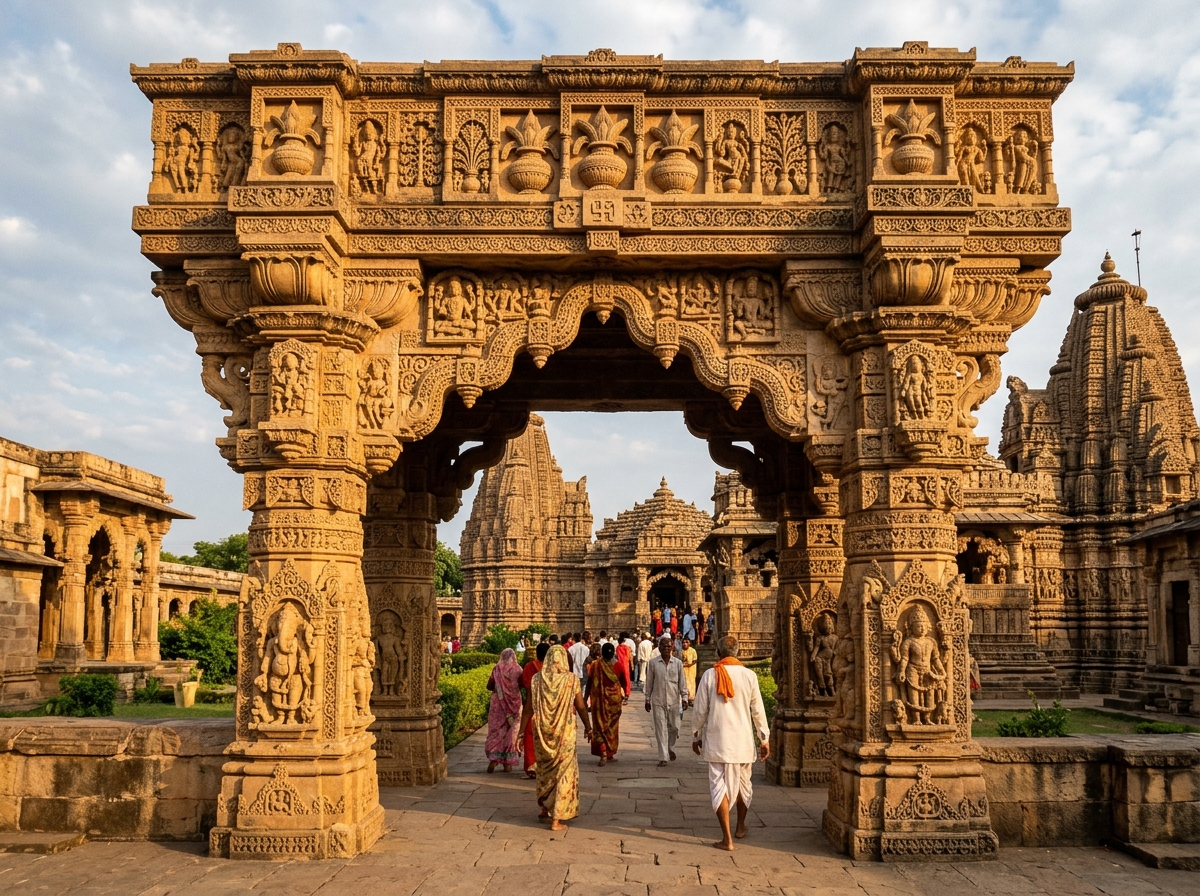
When Rajan Singh proposed a temple for Narendra Modi in July 2026, he said the community "did not have a temple of its own", as the Free Press Journal reported. That sentence invites a fair question: what do transgender and hijra devotees in India already have? The short answer is that the temple most often linked with transgender devotees is the very old Bahuchara Mata shrine at Becharaji in Gujarat, and a religious order called the Kinnar Akhara that has joined the Kumbh Mela. This article explains both. It also looks at the Bahuchara Mata temple and the transgender community, and where the sources disagree. It does not judge anyone's reasons for the Patna proposal.
Key takeaways
- The main temple of Bahuchara Mata is at Becharaji, in Mehsana district, Gujarat. Hijra devotees have a long-recognised place in its rituals, though Wikipedia notes they are not officially priests.
- The Kinnar Akhara is a religious order led by Laxmi Narayan Tripathi. Sources give 2015 or 2018 as its start, so we show both.
- It took part in the 2019 Kumbh Mela at Prayagraj under the umbrella of the Juna Akhara. Both sides described that link differently.
- Having these places does not settle whether a new, community-run temple is needed. That is a separate question.
- We found no source linking Bahuchara Mata or the Kinnar Akhara to the Patna Modi temple proposal.
Why this background matters
The Patna proposal was approved by the Bihar State Transgender Welfare Board on 29 July 2026, according to PTI via ThePrint. Mr Singh gave respect and rights as his reason. Reporters also repeated his line that the community had no temple of its own. Readers then asked, reasonably, whether that is true.
It depends on what "its own" means. There are famous places where transgender devotees are welcome and even central. There is also an order of ascetics (religious renunciates) that is led by transgender people. What is less clear is whether there is any temple owned and run by the community as a whole. This guide lays out what is documented so you can judge for yourself. For the wider story, see why the transgender community and a Modi temple are in the news.
Bahuchara Mata temple at Becharaji: where is it?
People search for this in several ways, including "bahuchara mata temple kahan hai". The main temple is in Becharaji (also spelt Bahucharaji), Mehsana district, Gujarat. Wikipedia places it about 82 km from Ahmedabad and about 35 km west of Mehsana town. It describes a complex of three shrines. The oldest, called Adyasthan, encloses a tree believed to mark the place where the goddess first appeared.
Bahuchara Mata is a Hindu goddess. In the local story, hijras are tied to her through a curse and a blessing, which you can read below. Wikipedia, quoting a government source, says about 1.5 million pilgrims visit the temple each year.
The story people tell about the goddess
Accounts differ, and Wikipedia says so. In the version Wikipedia gives, Bahuchara and her sisters were attacked by a bandit named Bapiya near Shankhalpur. They performed a ritual self-harm called traga, which cursed him to lose his manhood. Bahuchara then told him to build a shrine and worship her. She promised her blessings to men who are "naturally emasculated" and who wear women's clothes and worship her.
This is a legend, not recorded history, and we present it only as the tradition describes it. It is the reason many hijra devotees see the goddess as their protector.
What sources say about the community's role
According to Wikipedia, hijras, called Paviyas in Gujarati, are a group tied to the temple's story and rituals. The article says they are always present on the temple grounds and help pass on the goddess's grace. It also says they are not officially recognised as priests at the temple. This detail matters for our question: devotion and ritual presence are documented, but formal ownership or control of the temple by the community is not.
| Date | Event at Becharaji (per Wikipedia) | Note |
|---|---|---|
| 1152 CE | Original shrine said to be built by Sankhal Raj (Bombay Gazetteer) | Traditional date |
| 1280 CE | First surviving inscription that mentions it | Earliest written proof listed |
| 1721 | Pilajirao Gaekwad conquers eastern Gujarat | Start of Gaekwad ties |
| 1779 | Manajirao Gaekwad builds a temple after being cured, as the tradition says | Main building period |
| 1859 | Sayajirao Gaekwad III appoints a southern Brahmin to lead rituals | Change in who leads worship |
| 1954 | The Kamaliya exclusive revenue rights system is abolished | Ends an older management system |
The Kinnar Akhara: what it is
An akhara is an order of ascetics, often compared to a monastic community. National Geographic says the Kumbh Mela has 13 main akharas (Juna is the oldest). The Kinnar Akhara is led by Laxmi Narayan Tripathi, a transgender activist whom Wikipedia lists as its Acharya Mahamandaleshwar (a senior religious title).
The word kinnar is one of several terms used for hijra and transgender people. If you want a clear guide to the words, read our glossary of kinnar, hijra and transgender.
When did the Kinnar Akhara begin? Sources disagree
This is the part where careful reading matters. National Geographic, in an article by Priti Salian published on 30 May 2019, says the order was formed in 2015 by Ms Tripathi. Wikipedia's Kinnar Akhara page says it was established in 2018 by the hijra community. A third claim comes from Rishi Ajaydas (spelt Ajay Das elsewhere), who calls himself the founder. The Week reported on 31 January 2025 that he says he founded it at the Ujjain Kumbh and later appointed Ms Tripathi.
We cannot say which account is right, and none of them is a legal record. The safest wording is "formed in 2015 or 2018, depending on the source", with the founder's role disputed.
| Question | National Geographic (30 May 2019) | Wikipedia: Kinnar Akhara |
|---|---|---|
| Year formed | 2015 | 2018 |
| Founder named | Laxmi Narayan Tripathi | Not named; Tripathi listed as Acharya Mahamandaleshwar |
| First mela | Took part at Ujjain in 2016 | First transgender group to take part in a mela, Ujjain 2016 |
| Link to Juna Akhara | Juna accepted the order, giving a right to the royal bath | Placed under the Juna Akhada |
| Size | About 2,500 members, mostly transgender women | Not given |
The Kinnar Akhara at the Kumbh Mela
The Kumbh Mela is held in rotation at Haridwar, Nashik, Ujjain and Prayagraj. National Geographic describes the 2019 Ardh Kumbh at Prayagraj, which ran for 49 days from January to February. It reports that the Kinnar Akhara drew roughly 20,000 to 30,000 visitors a day, many seeking blessings or advice.
Here is how its treatment changed, as that article tells it:
- At Ujjain in 2016, the All India Akhara Parishad did not allow the order the royal holy dip (shahi snan) and gave it only a camping plot.
- At Prayagraj in 2019, the order received the same facilities as other orders.
- The Juna Akhara, described as the oldest of the 13, accepted the order, which gave its members the right to the royal dip.
The Juna link is disputed
National Geographic says Juna accepted the order, and Wikipedia places it under the Juna Akhada. But in January 2025 Mr Ajaydas called the 2019 agreement with Juna a fraud, according to The Week. He said it was made without his knowledge or signature. Whether it was a merger or a Kumbh-time arrangement is not clear from what we read.
A later dispute
On 31 January 2025, The Week reported that Mr Ajaydas announced Ms Tripathi's removal after she appointed the actor Mamta Kulkarni as a Mahamandaleshwar. Other reports say Ms Tripathi rejected the removal. In January 2026, ETV Bharat still called her Acharya Mahamandaleshwar, and said she announced Ms Kulkarni's expulsion after remarks about a Shankaracharya. So the leadership has been contested, and the 2025 removal does not appear to have held. Check current news.
Place or group, what sources say, what is still open
The table below puts the two places side by side, which news reports rarely do.
| Place or group | What it is | What sources say | Open questions |
|---|---|---|---|
| Bahuchara Mata temple, Becharaji | Goddess temple in Mehsana, Gujarat | Hijra devotees have a ritual role; about 1.5 million pilgrims a year; not officially priests | Who controls it today? How are hijra devotees treated in daily practice? |
| Kinnar Akhara | Religious order led by transgender people | Formed in 2015 or 2018; at the 2019 Kumbh; linked to Juna Akhara | Exact start date and founder; the Juna agreement, which Mr Ajaydas disputes; leadership |
| Kumbh Mela presence | Large pilgrim gathering held in rotation at four cities | Order was denied the royal dip in 2016, then given the right through Juna in 2019 | Whether the arrangement lasts at later Kumbhs |
| A community-owned temple | A temple run by and for the whole community | Mr Singh says none exists; we found no report of one | Whether the claim means ownership, not welcome |
How this relates to the Patna proposal
We can state only what is sourced. Mr Singh told reporters the community had no temple of its own, and that is quoted by the Free Press Journal. Becharaji and the Kinnar Akhara show that transgender devotees do have places of worship and a religious order, and that these are older than the Patna plan. Whether Mr Singh meant ownership, a temple in Bihar, or something else, we do not know, and we do not guess at his motives.
We found no report that Bahuchara Mata temple officials or the Kinnar Akhara commented on the Patna proposal. Other community voices have spoken: On 7 August, The Quint ran an opinion by Sanskriti Pandey arguing that a separate shrine "creates a ghetto". That is one writer's view. For the facts of the proposal, read our profile of Rajan Singh and the board. For the rights background, see the long road to equality and what changed in the 2026 amendment. More pieces are in the community and rights topic.
What we could not confirm
- The exact year the Kinnar Akhara was formed (2015 versus 2018).
- Whether the Juna Akhara tie in 2019 was a merger, an affiliation, or a Kumbh-only arrangement, and who founded the order.
- Who runs the Becharaji temple's daily rituals today, beyond what Wikipedia reports.
- Any reaction from either place to the Patna Modi temple plan.
- Whether any temple is owned by the transgender community as a whole.
This article is general information. It is based on public sources that we opened, and some of them are encyclopedia entries. For religious or legal decisions, check with the temple, the akhara or a qualified adviser.
In Tamil Nadu, the best-known gathering is at Koovagam. Read the Koovagam festival and the Aravan story.
Common questions
Where is the Bahuchara Mata temple?
The main temple is at Becharaji in Mehsana district, Gujarat. It is about 82 km from Ahmedabad, according to Wikipedia.
Is the Kinnar Akhara part of the Kumbh Mela?
Yes. It took part in the 2019 Kumbh at Prayagraj, and National Geographic reports that Juna Akhara accepted it. The terms of that link were described differently by each side.
Who leads the Kinnar Akhara?
Wikipedia lists Laxmi Narayan Tripathi as its Acharya Mahamandaleshwar. A January 2025 removal announced by Rishi Ajaydas was disputed, and ETV Bharat still called her by that title in January 2026.
When was the Kinnar Akhara founded?
National Geographic says 2015, while Wikipedia says 2018, and Rishi Ajaydas claims to be its founder. We cannot settle the difference.
Sources
- Wikipedia: Bahuchara Mata
- Wikipedia: Kinnar Akhara
- National Geographic: Transgender spiritual order finally finds acceptance at Hindu pilgrimage (30 May 2019)
- The Week: Kinnar Akhara head steps down (31 January 2025)
- ETV Bharat: Mamta Kulkarni out from Kinnar Akhara (27 January 2026)
- Wikipedia: Laxmi Narayan Tripathi
- Patna proposal: PTI via ThePrint and Free Press Journal, 29 July 2026
Last checked on 24 October 2026. Spotted a mistake? Tell us through our contact page.