In English, kinnar (किन्नर, also spelled kinner) usually means a transgender person, and especially a member of the hijra community. The word kinnar is used in Hindi for people of the hijra community, and often as a polite word for transgender people in general. In English news reports it is often translated as "transgender" or "third gender". So when you read about the Bihar State Transgender Welfare Board (in Hindi, the Bihar Rajya Kinnar Kalyan Board), the two names point to the same group of people. This page explains kinnar meaning in English, and every other hard word you may meet in this story.
Key takeaways
- Kinnar and hijra are community words. Transgender is the wider everyday and legal word. They overlap, but they are not always the same thing.
- "Eunuch" is an old translation that many community members reject. Avoid it unless you are quoting a law or a source.
- The 2019 Act and the 2026 amendment bill (passed by both houses of Parliament in March 2026, per PRS) use their own legal definitions, and the two differ in important ways.
- Temple words such as murti, garbhagriha and trust have specific meanings that matter when people discuss any new temple.
- Some words are disputed. When in doubt, use the word a person uses for themselves.
Why words matter in this story
On 29 July 2026, the Bihar State Transgender Welfare Board approved a proposal to build a temple for Prime Minister Narendra Modi, according to PTI. The proposer was board member Rajan Singh. Reports use many different words for the people involved: transgender, kinnar, third gender, hijra. Some readers use these words as if they mean the same thing. Others find a wrong word hurtful.
Getting the words right helps you read the news correctly. It also helps you stay respectful. A word that is fine inside a community can feel like an insult when a stranger uses it. And a word used in a law can mean something narrower than the same word in daily life.
Read this page alongside our explainers on why the community and the temple proposal are linked and on the 2019 Act. For other community-related pages, see the community and rights topic.
Quick glossary table: term, plain meaning, where it is used
| Term | Plain meaning | Where you will meet it |
|---|---|---|
| Kinnar (also kinner) | A Hindi word for people of the hijra community, often used for transgender people in general | Hindi news, the Bihar board's name, the 2019 Act |
| Hijra | A South Asian community of people who are transgender, intersex or sometimes called eunuch, often living in guru-led households | Law, history books, everyday speech |
| Transgender | Someone whose gender is different from the gender they were given at birth | Law, medicine, English news |
| Trans woman / trans man | A person who was given male (or female) at birth and lives as a woman (or man) | Everyday use; dropped from the categories in the 2026 amendment bill |
| Third gender | A legal category beyond male and female, recognised by the Supreme Court in 2014 | Court judgments, forms |
| Eunuch | An old English word for a castrated man; many community members reject it | Old laws, some official papers |
| Welfare board | A government body that plans schemes and listens to a community | Bihar, Tamil Nadu and other states |
| Certificate | An official paper that recognises a person's gender identity | 2019 Act, district magistrate offices |
| NALSA | The National Legal Services Authority, the first-named party in the 2014 Supreme Court case | Court and legal articles |
| Akhara | A Hindu religious order or group, historically linked to wrestling grounds and monastic traditions | Kumbh Mela, Kinnar Akhara |
| Guru-chela | Teacher and follower; the family-like structure inside hijra households | Community life |
| Murti | A sacred image or statue of a deity or saint used in worship | Temple discussions |
| Garbhagriha | The inner sanctum of a temple, where the main murti sits | Temple architecture |
| Trust | A legal body that holds property for a stated purpose | Temple management |
Kinnar meaning in English: origin and everyday use
The word comes from Sanskrit. In Hindu and Buddhist texts, a kinnara is a mythical being, part human and part bird or horse, linked with music and love. Wikipedia's article on kinnaras describes them as celestial musicians.
How the word came to mean transgender people today is not explained in the sources we opened, so we do not guess. What is clear is the present use. In Hindi, kinnar is a respectful, widely used word. It appears in the name of the Bihar board, in the name of the Kinnar Akhara, and in the 2019 Act, which names kinnars among the groups it covers.
The word is spelled several ways in English: kinnar and kinner. They are the same word in different spellings.
Is kinnar the same as transgender?
Not exactly. Kinnar names a community and a cultural identity. Transgender is a wide word for anyone whose gender differs from the one given at birth. Many kinnars are transgender. But not every transgender person calls themselves kinnar or belongs to that community. The next section shows why.
What is the gender of a kinnar?
There is no single answer, and the honest one is: the gender the person says they are. Most people in the hijra and kinnar community were assigned male at birth. Many live and describe themselves as women, and some describe themselves as a third gender. A few are intersex. In 2014 the Supreme Court recognised the right of transgender people to decide their own gender, as explained further down this page. So "kinnar" is not a gender in itself. It is a community that people of several gender identities belong to.
Hijra: a community and a social structure
According to Wikipedia's article on hijras, the term describes South Asian people who are transgender, intersex or eunuch, and who often live in communities organised around the guru-chela system. Hijras have generally been assigned male at birth, and a few are intersex.
How a hijra household works
- A guru heads a household called a dera and teaches community customs.
- The followers are chelas. The article compares the arrangement to what Western writers call a "found family".
- Households belong to wider lineages called gharanas, each led by a naayak.
Outsiders often misread this system. It is a family and support network first, because many people who join have left or lost their birth families.
Regional names
Different regions use different words. The same Wikipedia article notes that in Pakistan the community prefers "Khwaja Sara", and that in Tamil Nadu community terms such as "thirunangai" have largely replaced "aravani", which is often considered derogatory. The 2019 Act also names "jogta" alongside kinnar and hijra. These words are not interchangeable in daily life, so use the one the person uses.
Kinner meaning in Tamil
Tamil has its own respectful words. In 2022 the Tamil Nadu government published a glossary of terms for LGBTQIA+ people, as The News Minute reported. It uses thirunangai for a transgender woman and thirunambi for a transgender man. The umbrella word thirunar was formed from the shared "thiru" at the start of both. The older word aravani, linked to the Aravan story told at the Koovagam festival, is now often avoided.
The temple link is old. The goddess Bahuchara Mata, whose main temple is at Becharaji in Mehsana district, Gujarat, is regarded as a patron of the hijra community, according to Wikipedia. Our guide to Bahuchara Mata and other sacred places covers this in more detail.
Transgender, trans man, trans woman: the everyday and legal use
Transgender is the umbrella word used in English news, in medicine and in most government papers. Two related terms help:
- Trans woman: a person assigned male at birth who lives as a woman.
- Trans man: a person assigned female at birth who lives as a man.
- Intersex: a person born with body traits that do not fit the usual male or female pattern. This is about body, not identity.
Gender identity (who you know yourself to be) is not the same as sexual orientation (who you are attracted to). The two are separate questions.
What the Supreme Court said in 2014
In National Legal Services Authority v. Union of India, decided on 15 April 2014, the Supreme Court recognised transgender people as a "third gender". A two-judge bench of Justice K.S. Panicker Radhakrishnan and Justice Arjan Kumar Sikri also held that making surgery a condition for changing legal gender is illegal. The court directed that transgender people be treated as socially and economically backward and that reservations be extended in education and public jobs, per the Wikipedia summary of the case.
Terms in the 2019 Act and the 2026 amendment
Laws give words fixed meanings. The Transgender Persons (Protection of Rights) Act, 2019 defines a transgender person as someone whose gender does not match the one assigned at birth. It includes intersex persons, hijras, jogtas and kinnars, plus trans men, trans women and genderqueer persons, according to Wikipedia. Critics say it overlooks the reservations NALSA recommended and does not recognise self-declared gender identity.
The Transgender Persons (Protection of Rights) Amendment Bill, 2026 changes this. PRS Legislative Research, which tracks bills, records that it was introduced in the Lok Sabha on 13 March 2026, passed there on 24 March and passed by the Rajya Sabha on 25 March. We have not seen the notification that brings it into force, so check the official gazette for the current text. This is general information, not legal advice.
Old definition versus bill definition
| Point | 2019 Act | 2026 amendment bill (per PRS) |
|---|---|---|
| Basic definition | Gender does not match the one assigned at birth | General definition removed; a list of included persons instead |
| Trans men and trans women | Included | Removed from the list |
| Genderqueer persons | Included | Removed from the list |
| Persons forced into a transgender identity by mutilation, castration or similar procedures | Not listed | Added |
| Who recommends the certificate | Applicant applies to the district magistrate | District magistrate decides after a recommendation from a medical board headed by a Chief Medical Officer or Deputy CMO |
The details of the amendment are in our separate piece on what changed in the 2026 amendment.
Welfare board, certificate and NALSA
A welfare board is set up by a state government to plan schemes for a group of people and give them a voice. The Bihar board is a 28-member body under the Social Welfare Department, constituted in August 2025, according to Drishti IAS. Its first meeting was on 29 July 2026. Our guides to welfare boards across India and to the Bihar board give more detail.
A certificate under the 2019 Act is the document that lets a person change the name and gender entry on birth records. NALSA, as noted above, is the name of the legal body that brought the 2014 case, together with the community petitioners.
Kinnar Akhara and akhara
An akhara is a Hindu religious order. The Kinnar Akhara was established in 2018 and operates under the Juna Akhara, according to Wikipedia. Laxmi Narayan Tripathi is identified as its Acharya Mahamandaleshwar. The same article records that the 2016 Simhastha at Ujjain was the first mela where the community took part as an organisation, and that the group appeared at the 2019 Kumbh Mela. Bahuchara Mata is described as a spiritual patron of the wider community.
Kinnar akhara meaning, in short: a Hindu monastic-style order, run by and for people of the kinnar community.
Terms about temples: murti, mandir, trust, garbhagriha
These words come up every time a new temple is discussed, including the Modi Mandir proposal.
- Mandir: the Hindi word for temple.
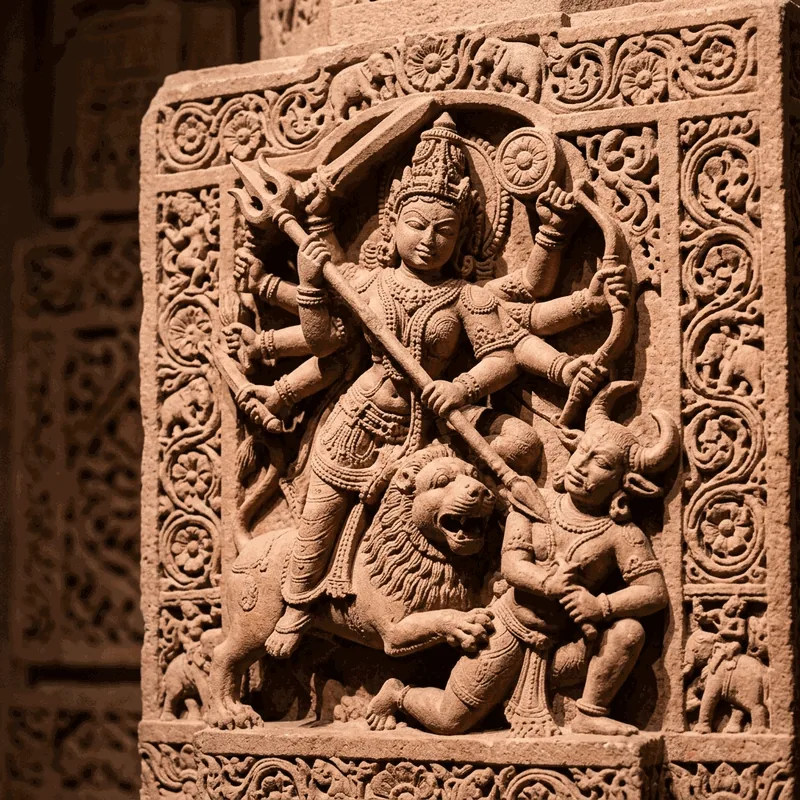
- Murti: a sacred image or statue of a deity or saint used in worship. Not every carving is a murti; decorative carvings on walls are not, per Wikipedia.
- Prana pratishtha: the rite that consecrates a murti. Read what prana pratishtha means.
- Garbhagriha: the small inner room where the main murti sits. See the parts of a Hindu temple.
- Trust: a legal body that owns and manages a temple's land and money. In Bihar, religious trusts are covered by a state law; see our note on trust registration in Bihar.
No trust, design or site has been confirmed for any Modi temple in Patna. These words are here to help you read reports, not to suggest such things exist.
Words to avoid and why
| Word or habit | Why it causes trouble | Better choice |
|---|---|---|
| "Eunuch" as a label | Activists asked the Ministry of Social Justice in 2013-14 to stop using it in official papers (Wikipedia) | Transgender, kinnar or hijra |
| Slang words for hijras | Insulting in many contexts | The person's own word |
| "It" for a person | Treats a human as an object | The pronoun the person uses |
| "Sex change" | Suggests surgery is required, which the 2014 judgment rejected | Gender transition or gender-affirming care |
| "Third gender" for everyone | Some trans men and women see themselves as male or female | Transgender, unless the person says otherwise |
Is the word hijra offensive?
It depends on who says it and how. Many community members use "hijra" about themselves with pride, and it is a legal term in the 2019 Act. But it is also used as an insult on the street. Even "hijra" is sometimes used in a derogatory way, according to the Wikipedia article. A good rule is to use the word a person uses about themselves, and to say plainly when you are quoting a law.
What we do not know yet
- We have not confirmed whether the 2026 amendment has been notified and is in force. We only know about its passage in both houses from PRS.
- Several background points here come from Wikipedia, and some lines on its pages are marked as needing citations. Treat them as general background.
- Reports on the Modi temple proposal use different words and pronouns for some people. We have kept the words each report used.
- The sources we opened do not explain how kinnar moved from a mythical being to a word for people.
For the 2014 Supreme Court case that recognised the third gender, read the NALSA judgment of 2014, explained.
Common questions
What is the kinnar meaning in English?
Kinnar, also spelled kinner, is a Hindi word for people of the hijra community, often used as a respectful word for transgender people. Its older root, kinnara, names a mythical being linked with music.
What is aravani in English?
Aravani is a Tamil word for transgender women. Many people in Tamil Nadu now prefer the word thirunangai, because aravani is often considered derogatory.
Are kinnar and transgender the same?
Not exactly. Kinnar names a community and cultural identity, while transgender is a wider word. Many kinnars are transgender, but not every transgender person is a kinnar.
Is hijra the same as transgender?
They overlap. Hijra is a specific South Asian community and social structure, while transgender is a wider word for anyone whose gender differs from the one given at birth.
What does Kinnar Akhara mean?
It is a Hindu religious order established in 2018 by the hijra community, working under the Juna Akhara. An akhara is a monastic-style order.
Is the word eunuch offensive?
Many community members reject it, and activists asked the government to stop using it in official papers. It still appears in some old laws and papers.
What is a murti?
A murti is a sacred image or statue of a deity or saint that is worshipped in a temple or shrine.
Sources
- The News Minute, "In a first, glossary of Tamil LGBTQIA+ terms published by TN govt", 2022
- PRS Legislative Research: The Transgender Persons (Protection of Rights) Amendment Bill, 2026
- Wikipedia: Hijra (South Asia)
- Wikipedia: Kinnar Akhara
- Wikipedia: Bahuchara Mata
- Wikipedia: Murti
- Wikipedia: Kinnara
- Drishti IAS, 31 July 2026, board clears proposal for PM Modi temple
- Wikipedia: National Legal Services Authority v. Union of India
- Wikipedia: Transgender Persons (Protection of Rights) Act, 2019
For more questions answered in short, see our FAQs and the timeline.
Last checked on 3 November 2026. Spotted a mistake? Tell us through our contact page.