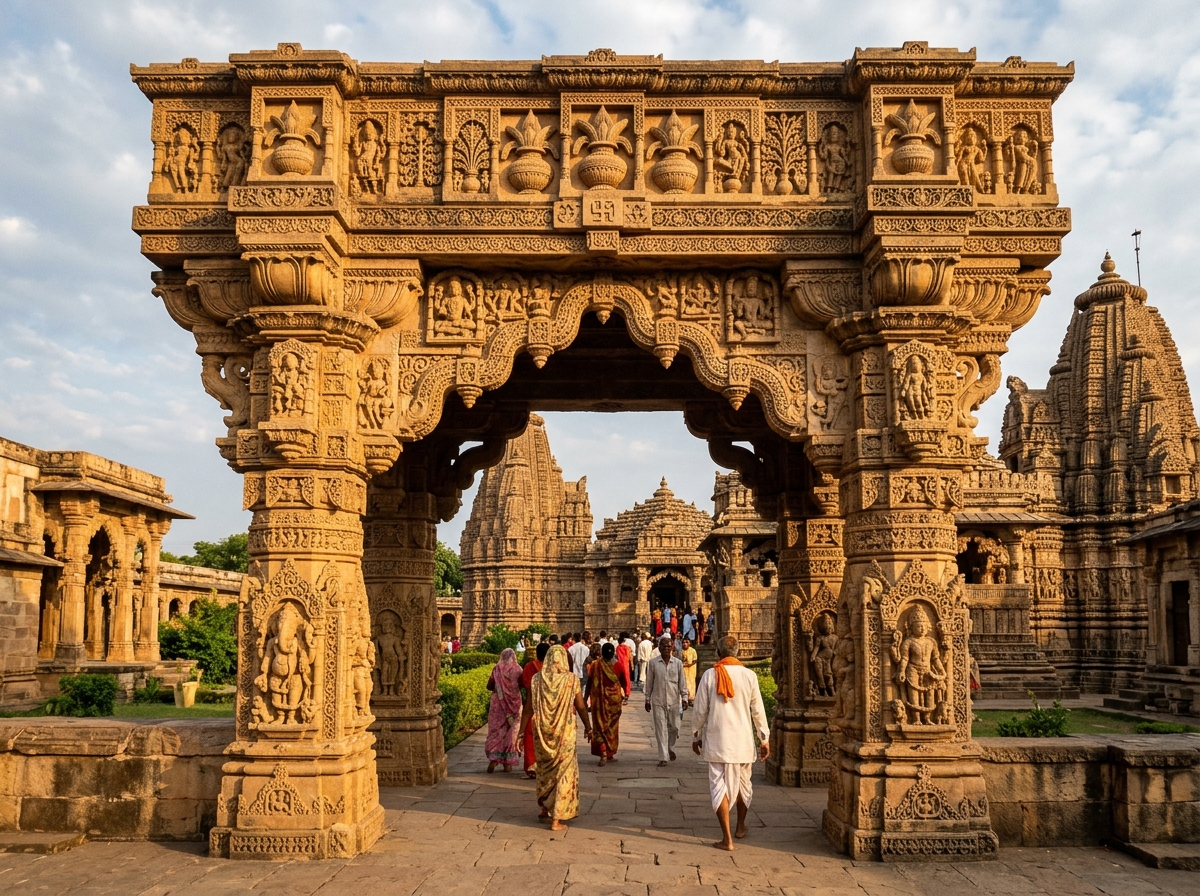
Memorials to leaders in India, such as statues, samadhis and memorial halls, exist to remember a person. A temple exists to worship a deity. That one difference shapes almost everything else: the design, who pays, who looks after the place, and the rules that apply. This article explains the difference with real examples, so you can read news about a statue or a temple proposal with more confidence.
Key takeaways
- A memorial honours a person's life and work. A temple is built around a deity and is used for worship.
- Memorials usually have an open plaza, a statue or a platform, and often a museum. Temples have a sanctum, a spire and a ritual layout.
- Public memorials are often paid for by governments, and courts have looked at that spending, as in the Mayawati statues case.
- Raj Ghat, the Statue of Unity and the Jayalalithaa memorial are real examples of three different kinds of memorial.
- The proposed Modi Mandir in Patna is a temple proposal, not a memorial. No land, money or design has been confirmed.
What is a civic memorial?
A civic memorial is a public place built to remember a person or an event. It can be a statue, a tomb-like platform, a park, a museum or a hall. People visit to learn, to pay respect and to take photos. They do not usually perform daily rituals to the person, because the person is remembered as a human being.
In India, memorials to leaders come in many forms. Some mark the place of a cremation. Some are tall statues. Some are museums with photographs and speeches. Governments, political parties and community groups have all built them.
How is a memorial different from a temple?
The table below gives a simple side-by-side view. It describes the usual pattern. Real places can mix features.
| Question | Memorial | Temple |
|---|---|---|
| Who or what is honoured? | A person or an event, remembered as history | A deity, worshipped as divine |
| Main purpose | Remembering, teaching, paying respect | Worship, rituals, festivals |
| Centre of the design | A statue, a platform, a flame or a hall | A sanctum (the inner room that holds the deity) |
| Who looks after it | Often a government department or a trust | A trust, a family, a community or a government board |
| Daily activity | Visitors walk through, read, take photos | Priests perform rituals, devotees offer prayers |
| Usual funding | Public money, donations, or both | Donations and offerings, sometimes public land or grants |
For a closer look at how a temple is laid out, see our guide to the parts of a Hindu temple. For the idea of the sanctum and why placing a living person there raises questions, see sanctum symbolism and living figures.
What does Raj Ghat teach us about memorial design?
Raj Ghat in New Delhi is the place where Mahatma Gandhi was cremated on 31 January 1948. According to the Wikipedia entry on the complex, the memorial is a black marble platform with an eternal flame at one end. A stone footpath leads to a walled enclosure. There is no sanctum and no idol. The design is quiet and open on purpose.
Over time, other leaders were given memorial sites nearby. The same entry lists places such as Shantivan for Jawaharlal Nehru, Vijay Ghat for Lal Bahadur Shastri, Shakti Sthal for Indira Gandhi and Sadaiv Atal for Atal Bihari Vajpayee. It also says that in 2000 the government decided not to create separate memorials for new leaders, because the existing ones already covered more than 245 acres of central Delhi land.
This tells us something useful. Memorials take land and money for the long term. Governments have sometimes decided that there is a limit.
What is the Statue of Unity, and is it a temple?
The Statue of Unity honours Sardar Vallabhbhai Patel, India's first Deputy Prime Minister. According to Wikipedia, it is 182 metres (597 feet) tall and stands near Kevadia in Gujarat, facing the Sardar Sarovar Dam. It was designed by the sculptor Ram V. Sutar and was inaugurated on 31 October 2018, the day that would have been Patel's 143rd birthday. Narendra Modi, then Prime Minister, presided over the ceremony.
It is not a temple. Visitors can go up to a viewing gallery at 153 metres, and the base has a museum about Patel's life. The point of the place is history and national pride, not worship.
Reports differ on the cost. Wikipedia gives a lead figure of about ₹27 billion (₹2,700 crore) and also mentions an estimate of about ₹2,063 crore and a contract of ₹2,989 crore. The page does not reconcile these. When you see one number in a headline, check what it includes.
What about statues of leaders who are alive?
The clearest Indian example of a legal fight over statues of a living leader is the Mayawati case. Mayawati, a former Chief Minister of Uttar Pradesh, built memorial parks in Lucknow and Noida that include statues of herself, other leaders and her party's elephant symbol.
Here is what the record shows:
- Advocate Ravi Kant filed a public interest petition in 2009 (a court case brought in the public interest). He argued the spending was arbitrary and sought an investigation. The cost he alleged is reported differently: The Tribune says more than ₹52 crore, while Outlook says about ₹2,000 crore for the statues and the party symbol. These are his allegations, not court findings.
- On 8 February 2019, a bench led by Chief Justice Ranjan Gogoi said it was of the "tentative view" that Mayawati should deposit the public money spent on the statues and the elephant symbol into the state treasury. A tentative view is an early opinion, not a final order.
- In an affidavit reported by Outlook on 2 April 2019, Mayawati said the statues reflected the decision of the state legislature and the will of the people. She said funds were approved through budget allocations, and that the memorials were meant to promote the ideals of saints and social reformers rather than her party symbol.
- On 15 January 2025, the Supreme Court closed the 2009 petition. According to LiveLaw, it did so because of later developments, mainly Election Commission instructions against using public money for party symbols. It told all political parties to follow those instructions. LiveLaw does not report any order to repay the money.
The lesson is simple. A statue is a public structure. If tax money pays for it, courts and voters can ask questions about it.
How is a leader's memorial hall different again?
Some memorials are built after a leader's death and combine a statue, a museum and a garden. The Jayalalithaa memorial in Chennai is one example. The News Minute reported in May 2018, when the foundation stone was laid, that it was designed as a structure called "The Phoenix", on the Marina beachfront next to her burial site and behind the memorial of M. G. Ramachandran. It described a white, wing-shaped main building with two lions at the entrance, photographs of her film and political career, a museum and a knowledge park. The report put the estimated cost at ₹50.8 crore. That was a plan at the time. We have not checked how the finished memorial looks today.
| Example | Who it honours | Kind of place | What the sources say about money |
|---|---|---|---|
| Raj Ghat, Delhi | Mahatma Gandhi | Open black marble platform with a flame | No cost given; the entry notes land limits (245+ acres for all memorials) |
| Statue of Unity, Gujarat | Sardar Vallabhbhai Patel | 182-metre statue, gallery and museum | Figures differ: about ₹2,063 crore, ₹2,700 crore or ₹2,989 crore |
| Mayawati memorial parks, Uttar Pradesh | Leaders, including Mayawati herself | Parks with statues | Disputed in court; allegations of ₹52 crore (Tribune) or ₹2,000 crore (Outlook) |
| Jayalalithaa memorial, Chennai | J. Jayalalithaa | Museum, photographs, knowledge park | Estimated ₹50.8 crore in 2018 |
Notice the features: a museum, photographs, gardens. A temple would instead be planned around a sanctum and rituals. Both can be beautiful. They do different jobs.
Where do the Modi temple stories fit in?
Several small temples or shrines for Narendra Modi have been reported in India. These are different from state-built memorials, because private followers or groups started them. Our reports on them are on separate pages:
- Rajkot in 2015, covered in the Rajkot Modi temple history. Reports differ on the cost and on what happened to the shrine.
- Meerut in 2017, an announced plan that we have found no proof of being built. See the Meerut Modi temple history.
- The wider pattern is described in temples for living politicians in India.
On 29 July 2026, the Bihar State Transgender Welfare Board approved a proposal from board member Rajan Singh (spelled Ranjan in PTI reports) to build a temple for Modi in Patna, according to PTI via ThePrint. Mr Singh said the community wanted to thank Modi for giving it "respect and rights". Later reports quoted him asking for five acres of land and ₹112 crore. Those figures come from his own statements. They are not a sanctioned budget. Our ₹112 crore fact check goes through the numbers.
Because this is described as a temple, it would be judged as a place of worship, not as a civic memorial. That affects who can fund it and how it is run. If you want to see the difference in law, read can a temple be built for a living person in India. This is general information, not legal advice.
What we do not know yet
Some things about the Patna proposal are still unconfirmed.
- We have found no report of a site being chosen or land being allotted.
- We have found no report of money being sanctioned.
- We have found no trust, architect or design for the temple.
- We have found no public statement on the proposal from the Prime Minister's Office or the Bihar government.
- We have not seen any court ruling about this temple.
For the full timeline of what is reported, see the timeline page. For architecture topics, our temple architecture hub lists the related guides, including the one on Nagara architecture.
How can you judge a memorial or temple proposal?
Here is a short checklist you can use for any proposal, in any state.
- Who is named as the owner or the builder? A trust, a department, a party, a private group?
- Where does the money come from? Look for a budget line or a signed order, not only a speech.
- Is there a plan or a drawing from a named architect?
- Has land been formally given? By whom and on what terms?
- Is the claim from the person proposing it, or from an independent source?
Our guide to checking viral claims goes deeper on the last point.
Common questions
Is a statue of a leader the same as a temple?
No. A statue is a public memorial that honours a person. A temple is a place of worship built around a deity, with a sanctum and rituals.
Who usually pays for a memorial?
It varies. Some are paid for from public budgets, some from donations and some from both. Courts have examined public spending on statues, as in the Mayawati case.
Is the Statue of Unity a temple?
No. It is a 182-metre statue of Sardar Vallabhbhai Patel, with a viewing gallery and a museum, inaugurated on 31 October 2018.
Is the proposed Modi Mandir in Patna a memorial?
It was proposed as a temple. As of 24 October 2026 we have found no confirmed land, funding or design for it.
Sources
- Wikipedia: Raj Ghat and associated memorials
- Wikipedia: Statue of Unity
- The Tribune: Mayawati has to deposit money used for erecting her statues, says SC
- Outlook: Mayawati justifies construction of her statues
- LiveLaw: Supreme Court disposes of 2009 PIL against Mayawati statues
- The News Minute: A sneak peek into The Phoenix
Last checked on 24 October 2026. Spotted a mistake? Tell us through our contact page.