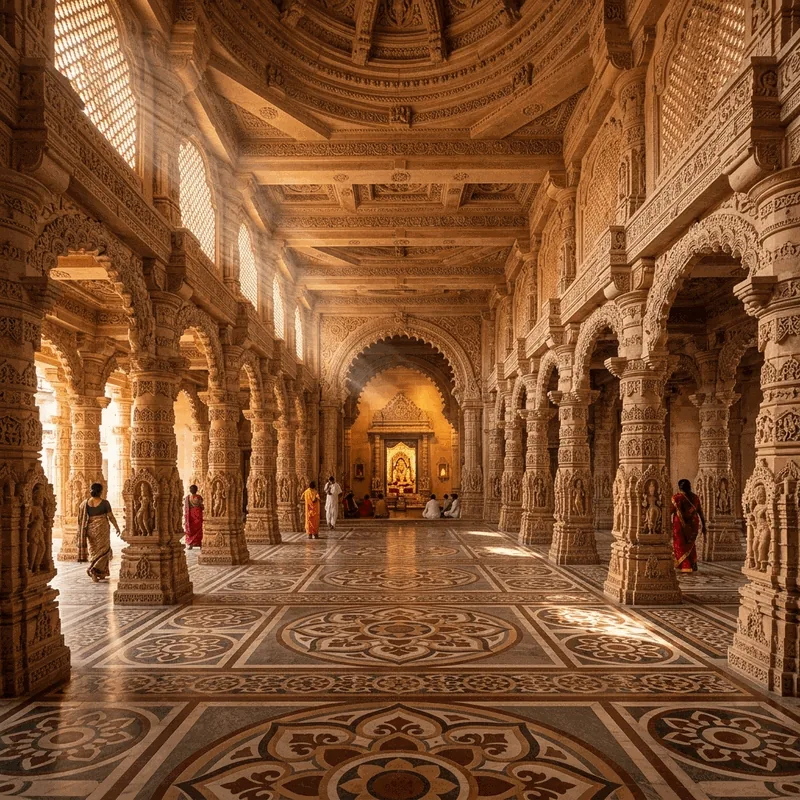
The garbhagriha (pronounced GAR-bha-gri-ha) is the innermost room of a Hindu temple, where the main sacred image sits. The word comes from Sanskrit: garbha means womb and griha means house, so it is often translated as "womb chamber". It is small, usually dark, and usually has one door.
This guide explains that room, and then answers a question that has come up since a Bihar board approved a proposal for a temple dedicated to Prime Minister Narendra Modi: what makes an image sacred, and why do some people object to images of living people in a sanctum? We describe both views and attribute them. We do not take a side.
Key takeaways
- The garbhagriha is the innermost chamber of a Hindu temple. It holds the murti, the sacred image of the main deity.
- In tradition, an image becomes a deity's seat through a rite called prana pratishtha, which means "establishing life".
- Traditionally, only the priests who serve the temple enter the sanctum.
- Critics and supporters of the Patna proposal disagree about whether a living leader belongs in a place of worship. Both sides have named arguments.
- No design, site or plan for a sanctum in the proposed Patna temple has been published.
What is the garbhagriha, and what does the word mean?
Think of a Hindu temple as a building that grows outward from one small room. That room is the garbhagriha. English writers often call it the "sanctum" or "sanctum sanctorum", which means the holiest inner place.
According to the Wikipedia entry on the garbhagriha, early sanctums were circular, as at Gudimallam, which is dated to the 3rd century BCE. Later ones became roughly square, close to a cube. Compared with the whole temple the room is small. It usually has no windows, one entrance (facing east) and very little light. The dim light is meant to help a visitor focus on the image.
The word garbha also hints at birth. The same entry says a visitor entering the chamber is likened to an embryo coming to a new birth. This is a symbolic reading, not a rule that every temple follows.
A quick glossary
- Murti: the sacred image of a deity, in stone, metal or another material.
- Shikhara: the tower over the sanctum in northern India. In the south the tower is called a vimana.
- Mandapa: a pillared hall in front of the sanctum where visitors gather.
- Antarala: the small passage joining the hall and the sanctum.
- Pratishtha: "establishing", the act of setting up an image with ritual.
- Darshan: "seeing". In Hindu worship, looking at the image and being seen by it.
Where does the sanctum sit in the whole temple?
The sanctum is the centre. The tower rises straight above it, and the halls lead towards it. A visitor walks from the open courtyard, through a hall, past the passage, and arrives at the door of the sanctum. The Wikipedia entry notes that the tower is read as the vertical axis of the temple, standing for the world axis through the mythical Mount Meru, while the sanctum sits on the horizontal axis.
| Part | What it is | Who usually goes there |
|---|---|---|
| Garbhagriha | Innermost chamber with the main image | Priests who serve the temple |
| Antarala | Small passage before the sanctum | Mostly priests; customs differ |
| Mandapa | Pillared hall | All visitors |
| Shikhara or vimana | Tower above the sanctum | Seen from outside |
Customs differ from temple to temple, so treat the table as a general guide. For a fuller walk through the building, read our guide to the parts of a Hindu temple. For the northern style of towers and carved stone, see our Nagara architecture guide.
What is inside the sanctum?
The sanctum holds the murti of the temple's main deity. Depending on the temple, this can be an image of Vishnu or a goddess, or a lingam (a rounded stone form) for Shiva. The Wikipedia entry adds that the Rajarani temple at Bhubaneswar has an empty dark chamber with no symbol at all. So even the idea of "an image inside" has exceptions.
Many visitors call the image an idol. Many worshippers prefer the word murti, because to them it is not a decoration but a form in which the deity can be met. A key idea here is darshan, meaning "seeing". For a worshipper, simply looking at the image is an act of worship, and many reviewers of Diana Eck's book Darsan: Seeing the Divine Image in India describe seeing as central to Hindu worship.
How does a stone image become a deity?
In Hindu tradition, a carved image is not worshipped as a deity until a special rite is done. That rite is prana pratishtha (murti pratishtha is a close term for the establishing of an image). Prana means life or breath, and pratishtha means "to be established".
Wikipedia's entry on the rite lists these stages in Hindu practice:
- Purification (shuddhi): the image is cleaned of impurities.
- Invitation (avahana): the deity is invited into the image with mantras, which are sacred verses.
- Infusion of life (prana pratishtha): the priest places a hand on the heart of the image and recites mantras.
- Offerings (upachara): flowers, fruit and incense are offered.
- Opening of the eyes (netra pratishtha): the eyes are touched with a golden tool. The entry says this marks the moment the image "comes to life".
After this, regular daily worship follows. The entry says these practices are described in scriptures such as the Agamas and Tantras. It also says that in Jainism a similar rite is understood differently: the image stands for the ideal qualities of the Tirthankaras rather than a divine presence.
A worked example
The Ram temple in Ayodhya held its consecration on 22 January 2024. The Quint and other outlets called the ceremony "Pran Pratishtha". The name shows how central the rite is to how a temple is understood: it is the step that, in tradition, turns a carved image into a presence to be worshipped.
Why do images of living people raise debate?
The simple reason is that the rite above was designed for a deity, not for a person. The tradition of consecrating images is about inviting the divine into stone. When the image shows a living person, readers ask different questions. Is the person being honoured, or being worshipped? Who decides? And what happens to the sanctum, the holiest room, if the image there is of someone who is alive and holds public office?
We did not find a published statement from any recognised religious authority on whether a living person's image can be consecrated in a sanctum. We also did not find a statement from the proposers saying that the image would receive the full rite. So the debate today is mostly a public one, held in the news and in opinion columns, not a ruling by priests or courts.
The case from supporters
PTI reported on 29 July 2026 that the Bihar State Transgender Welfare Board approved a proposal for a temple for Mr Modi at its first meeting in Patna. The report, carried by ThePrint, quotes the proposer, board member Rajan Singh (PTI spells the name Ranjan), as saying he proposed it because Mr Modi "gave us respect and rights". Free Press Journal reported that Mr Singh said the transgender community "did not have a temple of its own".
In this view, the temple is a way of saying thank you, and of giving a community a place that feels like its own. Supporters see gratitude, not a claim that Mr Modi is a god. We have not seen a statement from the board describing what, if anything, would be placed in a sanctum. For the background to the community's reasons, read why the transgender community proposed a Modi temple in Bihar.
The case from critics
On 7 August 2026, The Quint published an opinion piece by Sanskriti Pandey, a research scholar at JNU. The piece is titled "Building a 'Modi Shrine' for Transgender People Does the Opposite of Inclusion". Most of it is behind a paywall, so we can describe only the opening. Its sub-heading says a separate shrine "creates a ghetto". The visible text also argues that an elected leader doing his constitutional duties should not be treated as divine.
These are the author's opinions, not findings of fact. Other critics have raised questions about spending, law and process. We cover those in separate pieces. See can a temple be built for a living person in India? for the legal side.
Note: Even people who agree on the facts can disagree about what a sanctum image means. For some it is worship. For others it is a statue with a respectful purpose. This site reports both views and does not decide between them.
Is this idea new?
No. Honouring living leaders in this way has happened before. Our pieces look at the long history in the history of honouring living figures as divine, and at earlier Modi temples in Rajkot and Pune. Reports of those cases differ in detail, so please read the sourcing in each article.
| Question | What supporters say | What critics say |
|---|---|---|
| What is the purpose? | Thanks for respect and rights, in Mr Singh's words | A leader should not be an object of worship (The Quint opinion) |
| Is a separate shrine good? | The community has no temple of its own | A separate shrine can create a "ghetto" |
| Who decides? | The board approved the idea, according to PTI | One board member disputes it, according to Queerbeat |
What we know, and what we do not know yet
What we know
- The board approved a proposal for a Modi temple on 29 July 2026, according to PTI.
- Mr Singh said the community wants a temple of its own, and cited Mr Modi's support for respect and rights.
- One opinion writer has argued against it. Other voices have also raised questions.
What we do not know yet
- Whether any site has been chosen. We found no report of land being identified or allotted.
- Whether there will be a sanctum, what image it would hold, or whether a prana pratishtha would be done. No design has been published.
- Whether the central or Bihar government supports the plan. We found no official statement.
- Whether the full board supports the plan. Mr Singh says it does. Board member Anupriya Singh has disagreed, according to Queerbeat.
Be careful with viral posts that show renderings, "approved" budgets or a sanctum plan. We found none from an official source. For the money claims, see our fact-check of the Rs 112 crore figure.
Common questions
What does garbhagriha mean in English?
It means "womb chamber" or "womb house". It is the innermost room of a Hindu temple, where the main image is kept.
Can anyone enter the garbhagriha?
Traditionally only the priests who serve the temple enter it. Rules vary by temple, so check local custom before visiting.
What is murti pratishtha?
It is the rite of establishing an image in a temple so that it can be worshipped. It is also called prana pratishtha, meaning "establishing life".
Has any image of a living person been consecrated in the Patna proposal?
No. The Patna temple is only a proposal. We found no site, design or consecration plan in any report.
Sources
- Wikipedia: Garbhagriha, for meaning, design and contents of the sanctum.
- Wikipedia: Prana pratishtha, for the stages of the consecration rite.
- PTI via ThePrint, 29 July 2026, on the board decision and Mr Singh's quote.
- Free Press Journal, 29 July 2026, on the proposal and the community's reasons.
- The Quint opinion by Sanskriti Pandey, 7 August 2026, for the critical view (opening section only).
- The Quint on the Ram temple Pran Pratishtha, for the 22 January 2024 date.
See also our temple architecture topic page and the FAQ page.
Last checked on 24 October 2026. Spotted a mistake? Tell us through our contact page.