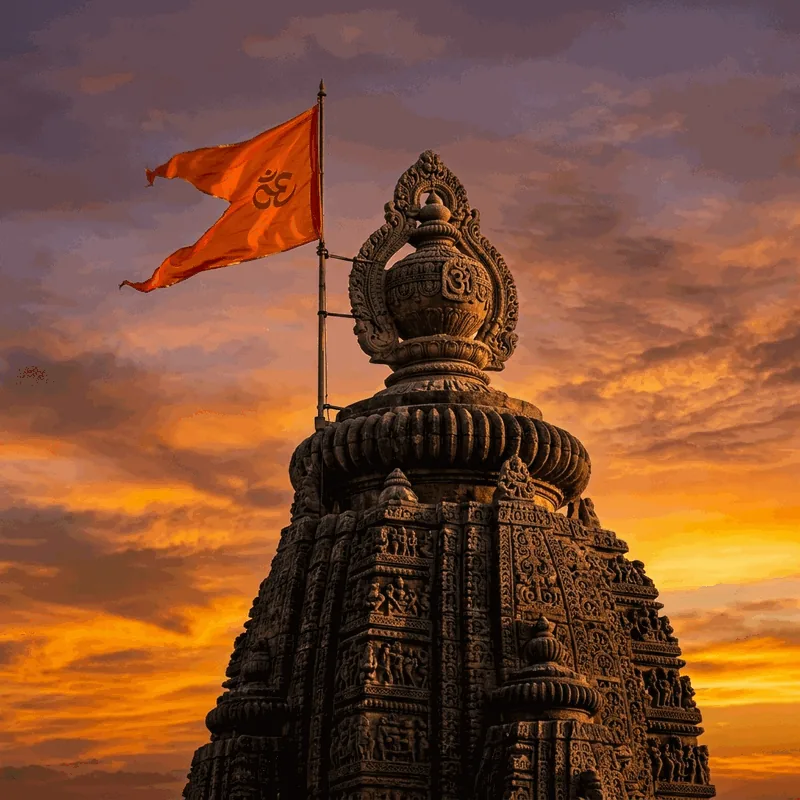
A shikhara is the tall tower that rises above the inner sanctum of a North Indian Hindu temple. The three shikhara types you will meet most often are Latina (one smooth, curved spire), Sekhari (a main spire with smaller spires attached to its sides) and Bhumija (a grid of tiny spires set in rows and columns). This guide explains each type in plain words, with a comparison table, real temple examples and a checklist for your next visit.
This is a general reference about temple building. It says nothing about the design of any proposed Modi Mandir, because no design has been published. For the wider topic, see our temple architecture hub.
Key takeaways
- Shikhara is a Sanskrit word that means "mountain peak". It is the tower over the garbhagriha, the small inner room that holds the main image.
- Latina is a single curved spire and the simplest type. Sekhari adds smaller spires that echo the main one. Bhumija uses rows of miniature spires and looks more like a stepped pyramid.
- Most shikhara types end with an amalaka (a ribbed, disc-shaped stone) and a kalasha (a pot-shaped finial).
- In South India the same tower is usually called a vimana, and the tall gateway towers are called gopurams. They are different things.
- Old temple types overlap, and scholars do not always agree on how to label one tower. Treat the labels as a guide, not a rule.
What is a shikhara and what does the word mean?
Shikhara (also spelled shikhar or sikhara) is a Sanskrit word for a mountain peak. According to Wikipedia's article on the shikhara, it is the rising tower of North Indian temples and is also used for many Jain temples. It stands directly above the garbhagriha, the sanctum where the main deity is placed. You can read more about the inner room in our guide to the sanctum and its symbolism.
The name fits the shape. The tower rises like a peak above the room below it, and from far away it shows a visitor where the main shrine is, long before they reach the door.
The tower belongs to the Nagara style, the style of Northern India. If you want the full comparison with southern and Deccan styles, read Nagara, Dravida and Vesara temple styles. For how the stone is cut and joined, see our Nagara architecture and sandstone guide.
Quick table of the three shikhara types
This table puts the three types side by side. The regions and examples come from the sources listed at the end of the article.
| Feature | Latina | Sekhari | Bhumija |
|---|---|---|---|
| Basic look | One curved spire, smooth lines rising to the top | Main spire with smaller spires attached to its sides | Rows and columns of miniature spires, a grid effect |
| Feel of the outline | Strongly upward, curved | Layered and busy, still upward | Less steep, often close to a pyramid |
| Other names or terms | Rekha deula in Odisha | Attached sub-spires are called urushringa | Probably first appears around 1000 to 1025 CE |
| Where it is found | Widespread across North India, including Odisha | Clustered spires are seen at Khajuraho in central India | Mainly the northern Deccan and western India |
| Example temples | Lingaraja Temple, Bhubaneswar; Vamana Temple, Khajuraho | Kandariya Mahadeva Temple, Khajuraho (84 miniature spires; a clustered example, see below) | Shiv Mandir, Ambarnath (begun in the 1050s) |
Note that the "feel of the outline" row is a plain description, not a technical rule. Temple builders did not follow one rulebook across a thousand years.
Latina: the single curved spire
Latina is the simplest and most common form. Wikipedia describes it as having four faces, each of which may carry a vertical projection called a ratha. The parts of the tower rise in one smooth curve, so the whole spire looks like a single piece. Writers sometimes call it "homogeneous" for that reason.
In Odisha the same idea is called the rekha deula, a name for the sanctum and the tower over it. According to Wikipedia, the Latina form was well established in Odisha by at least 600 CE. The Lingaraja Temple in Bhubaneswar is a well-known example of the Odisha form.
At Khajuraho, the story is more mixed. Wikipedia notes that smaller-spire forms appear there early in the 10th century, and that plain Latina forms come back after about 1050, as in the Vamana Temple.
Mahabodhi: a straight-sided cousin
The Mahabodhi Temple at Bodh Gaya in Bihar is often mentioned in this subject. Wikipedia says its central tower is about 55 metres (180 feet) high, straight-sided, and built of brick covered in stucco, in the shape of a stepped pyramid with a small stupa on top. It says the present structure is generally dated to the Gupta period, the 5th to 6th century CE, and may restore earlier work. Its tower is tall and tapering rather than curved, so we do not label it Latina. It shows that early towers took more than one shape.
Sekhari: spires with smaller spires attached
A Sekhari tower still has a main spire, but smaller copies of it are fixed against its sides. These attached copies are called urushringa. Wikipedia explains that there can be secondary and even tertiary sizes, with the smallest spirelets near the corners or the ends of each face.
The best-known example is the Kandariya Mahadeva Temple at Khajuraho in Madhya Pradesh. Wikipedia dates its construction to 1025 to 1050 CE, in the reign of the Chandela ruler Vidyadhara, and gives its height as 31 metres (102 feet). The same article says the tower carries 84 miniature spires, and that the temple became a UNESCO World Heritage Site in 1986. The pages we read do not call it Sekhari by name, so we offer it only as an example of the clustered look that this type is known for.
One more fact from Wikipedia's shikhara article is worth knowing. Among the many temples of Bhubaneswar, only the Rajarani Temple has significant spirelets of this kind. So clustered spires are not the norm in Odisha, where the single curve dominates.
Bhumija: a grid of miniature spires
Bhumija towers look different at first glance. Instead of one curve with attached spires, you see small spires laid out in horizontal and vertical rows, like a grid of tiles. Wikipedia says the result is less strongly vertical and often close to a pyramid in outline.
The type is found mainly in the northern Deccan and western India. Wikipedia says it probably first appeared around 1000 to 1025 CE. It gives the Shiv Mandir at Ambarnath, begun in the 1050s, as a historical example. We have not verified further dates for individual Bhumija temples, so we do not list more.
Amalaka and kalasha at the top
Look at the very top of a Nagara tower and you will usually see two parts stacked together.
- Amalaka: a ribbed, disc-shaped stone. It sits near the top of a Latina shikhara. In Odisha, Wikipedia says it is typically large and rests on four lion figures that face outward.
- Kalasha: a pot or urn, sometimes called a water pot. Wikipedia says every style of shikhara or vimana ends with one.
Think of the amalaka as the crown and the kalasha as the jewel set on it. For the other named parts of a temple, from gate to spire, see parts of a Hindu temple explained. The ritual of bringing an image to life inside the sanctum is covered in our prana pratishtha explainer.
How a shikhara differs from a southern vimana and gopuram
The word shikhara is used differently in the south. In Dravidian temples the tower over the sanctum is called a vimana. There, Wikipedia says, "shikhara" refers only to the top stage, usually a dome with a finial.
A gopuram is something else again. It is the large gateway tower of the temple wall. Wikipedia's gopuram article says it has tiers that shrink as they rise, a hollow interior, painted sculpture on the outside, and bulbous finials called kalasams on top.
| Term | Where it stands | Usual region | Shape |
|---|---|---|---|
| Shikhara | Over the sanctum | North India | Curved, clustered or grid-like spire |
| Vimana | Over the sanctum | South India | Tower over the sanctum, topped by a shikhara stage |
| Gopuram | Over a gateway in the wall | South India | Tall, tiered, richly painted |
In the south, the gopuram is often taller than the vimana. Wikipedia explains that the vimana was seen as very old and sacred, so builders added gateway towers rather than replace it. The tallest example it names is the rajagopuram of the Ranganathaswamy Temple at Srirangam, 73.0 metres (239.5 feet), completed in 1987.
A worked example: reading the Konark ruins
The Konark Sun Temple in Odisha shows why labels need care. Wikipedia says it was built around 1250 CE under King Narasingha Deva I of the Eastern Ganga dynasty, in the Kalinga style. UNESCO listed it in 1984. The main sanctum tower collapsed in 1837, and the sanctum no longer has a roof.
What survives is the jagamohana, the audience hall, which is about 39 metres tall. The lost tower is estimated at more than 61 metres (200 feet) in one part of the article and about 70 metres in another. Sources do not agree, so quote the height as "estimated". The lesson is simple. When a tower is gone, we can describe the hall that is left, but we should not claim to know exactly how the tower looked from the ruins alone.
How to spot each type on a visit
Use this short checklist when you stand in front of a temple. Start from a distance and move closer.
- Look at the outline from the front. A single smooth curve points to Latina.
- Count the layers. If smaller copies of the spire seem glued to the sides, think Sekhari.
- Look for rows. If the surface looks like a grid of tiny spires, think Bhumija.
- Find the amalaka, the ribbed disc, near the top.
- Check the very top for the kalasha pot.
- Ask a local guide or the temple board about the date. Many temples were repaired or rebuilt, so what you see may not match its original form.
If you want to learn more, do this
- If you are a beginner, read the parts guide first, then this page.
- If you are comparing north and south, start with the styles comparison.
- If you are planning a trip to Bihar, see our architecture hub and the FAQ page for related answers.
What we do not know yet
- No design, architect or tower style has been announced for the proposed Modi Mandir in Patna, so nothing here applies to it.
- Scholars use the terms Latina, Sekhari and Bhumija loosely, and the sources we read do not name a type for every famous temple.
- Exact dates and heights vary by source, as the Konark example shows. Wikipedia pages are summaries, so for a firm date or height check a survey or museum source.
If you are comparing North and South Indian towers, read the difference between shikhara, vimana and gopuram.
Common questions
What is the main difference between Latina and Sekhari?
A Latina tower is one curved spire. A Sekhari tower has the same main spire with smaller spires attached to its sides.
What does Bhumija mean in temple building?
Bhumija is a tower made of rows and columns of miniature spires, giving a grid look. It is found mainly in the northern Deccan and western India.
What are the amalaka and kalasha?
The amalaka is a ribbed, disc-shaped stone near the top of the tower. The kalasha is the pot-shaped finial above it.
Is a shikhara the same as a gopuram?
No. A shikhara stands over the sanctum of a northern temple. A gopuram is a tall gateway tower, mostly seen in South India.
Sources
- Shikhara, Wikipedia
- Hindu temple architecture, Wikipedia
- Gopuram, Wikipedia
- Konark Sun Temple, Wikipedia
- Kandariya Mahadeva Temple, Wikipedia
- Mahabodhi Temple, Wikipedia
Last checked on 24 October 2026. Spotted a mistake? Tell us through our contact page.