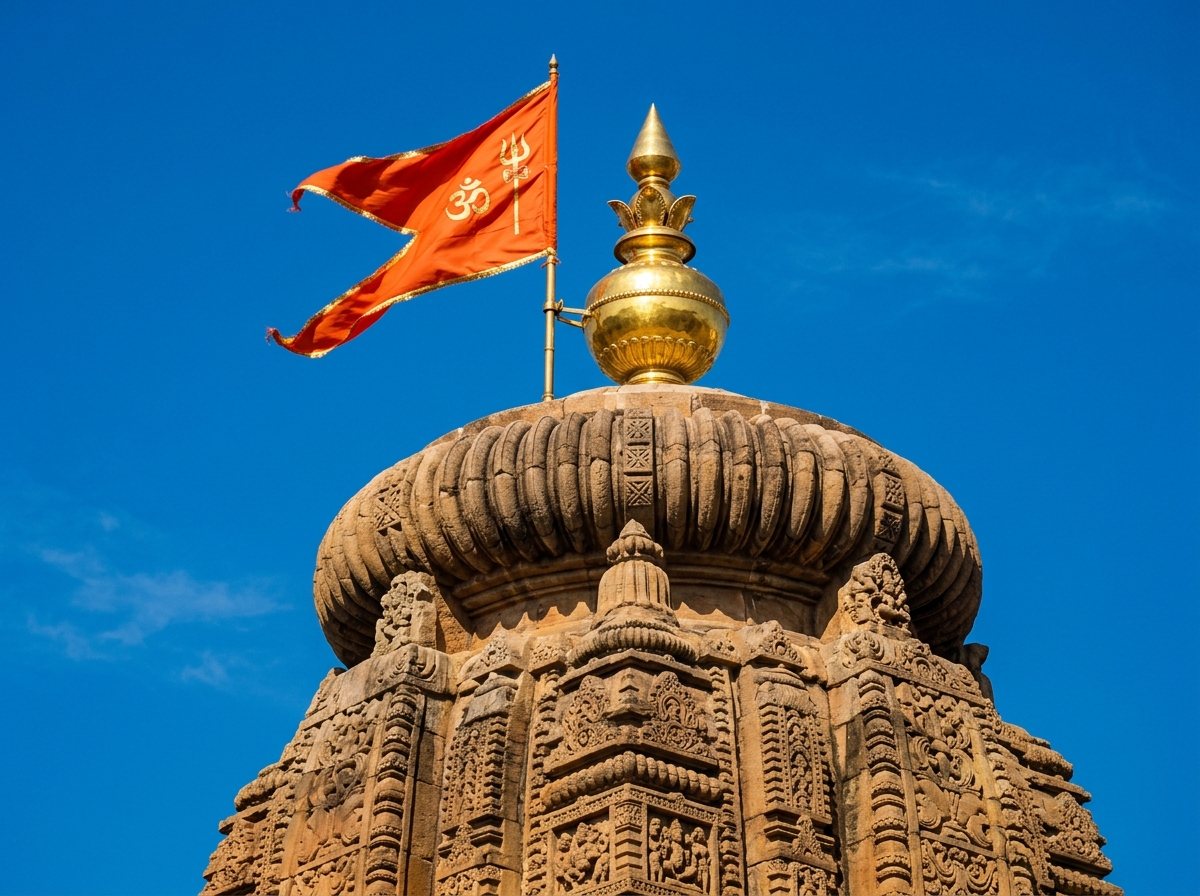
The main difference between a shikhara and a vimana is region and scope. A shikhara is the North Indian (Nagara) name for the curved tower that rises over the sanctum, while a vimana is the South Indian (Dravida) name for the whole shrine building, with its stepped, pyramid-shaped tower. A gopuram is something else again: it is a gateway tower in the wall around a South Indian temple, so it does not stand over the deity at all.
Below we set the three words side by side, explain why some southern gateways outgrew the shrine, and give a checklist for a visit. For a full tour of a temple, see our guide to the parts of a Hindu temple.
Key takeaways
- Shikhara and vimana both rise over the garbhagriha, the room that holds the main image. Shikhara is the northern term, vimana the southern one.
- In southern texts, "shikhara" means only the dome-like cap at the top of the vimana, not the whole tower.
- A gopuram is a gateway tower in the outer wall of a South Indian temple. It is an entrance, not a shrine.
- In many later southern temples, such as Madurai and Srirangam, the gateways are far taller than the sanctum tower. Thanjavur, built in the early 11th century, is the famous case where the vimana is taller.
- Published heights for these towers often differ by a few metres, so we give the range where sources disagree.
What do shikhara, vimana and gopuram mean?
All three words describe tall parts of a Hindu temple. The confusion starts because two of them mean slightly different things in north and south India.
Shikhara
Shikhara is a Sanskrit word that means "mountain peak". Britannica defines it, in North Indian temple architecture, as the tower or spire above the sanctuary, and also above the pillared halls. It calls it the most dominant feature of the northern Hindu temple. The usual northern shikhara has a curved outline and is crowned by a ribbed stone disc and a pot-shaped finial. We explain its sub-types in a separate page on Latina, Sekhari and Bhumija shikharas.
Vimana
Vimana (Sanskrit vimāna) has several old meanings. The Monier-Williams Sanskrit dictionary, as reproduced on Wisdom Library, lists "a car or chariot of the gods", "the palace of an emperor" and "a temple or shrine" among them. In South Indian temple building, the vimana is the shrine itself: the square sanctum together with the stepped tower above it. Britannica's entry on South Indian temple architecture describes this tower as an arrangement of gradually receding storeys in a pyramid shape, topped by a dome-shaped cupola and a crowning pot and finial.
So "vimana meaning" depends on the context. In a Sanskrit story it can be a flying chariot. In a South Indian temple it is the main shrine with its tower.
Gopuram
Gopuram (also gopura) comes from Sanskrit go, often translated "cow" or "earth", and pura, "city" or "enclosure". It first meant a city gate. In temple use, Britannica describes how South Indian temples grew larger over time, with a number of enclosures added, "each with its own gateway (gopura)". The gopuram is the tower built over each of these gateways. It is usually rectangular at the base, rises in many tiers, and is covered with painted figures.
Shikhara vs vimana vs gopuram: comparison table
| Question | Shikhara | Vimana | Gopuram |
|---|---|---|---|
| Where is it? | Over the sanctum (and sometimes over halls) | Over the sanctum; the word covers the whole shrine | Over a gateway in the outer wall |
| Usual region | North and central India (Nagara style) | South India (Dravida style) | South India, mainly Tamil Nadu and neighbouring states |
| Typical outline | Curved, beehive-like spire | Stepped pyramid of storeys | Tall, tiered, often rectangular, with a barrel-shaped top |
| What is inside? | The garbhagriha with the main image below it | The garbhagriha with the main image | A passage that visitors walk through |
| Usual top | Amalaka (ribbed disc) and kalasha (pot) | Dome-like cap (the southern "shikhara") with a finial | A row of pot-shaped finials, called kalasams |
| Classic example | Kandariya Mahadeva, Khajuraho | Brihadisvara, Thanjavur | Rajagopuram, Srirangam |
The short version: if it stands over the god, it is a shikhara (north) or a vimana (south). If you walk through it, it is a gopuram.
Why does "shikhara" mean different things in the north and south?
This is the single biggest source of mix-ups. Britannica notes that, according to South Indian architecture texts, the word shikhara is kept for the dome-shaped crowning cap only. Art historians, it adds, have generally used the word for all temple spires, north and south. That is why you will read "the shikhara of the Brihadisvara temple" in one book and "the vimana of the Brihadisvara temple" in another, both meaning the same tower.
The UNESCO description of the Thanjavur temple uses the southern sense. It says the vimana rises in 13 talas (storeys) and "is surmounted by an octagonal sikhara". Here the sikhara is the eight-sided cap at the very top, not the whole tower.
Eastern India adds one more twist. In Odisha, the main temple building is also often called a vimana, even though its tower is curved like a northern shikhara. UNESCO's page on the Sun Temple at Konark, for example, says its vimana "was surmounted by a high tower with a shikhara (crowning cap), which was razed in the 19th century". So the words overlap at the edges. Our page on Nagara, Dravida and Vesara styles explains how the regional styles themselves differ.
Why is the gopuram often taller than the vimana?
At Madurai or Srirangam, the giant painted towers you see from the road are not over the god at all. The sanctum towers inside are much smaller. Sources give a fairly consistent story for how this happened.
- Early gateways were modest. Wikipedia's article on the gopuram says the 11th-century Chola temples at Thanjavur and Gangaikonda Cholapuram had multi-storey gopurams larger than earlier ones, but still "dwarfed by the central vimana".
- Temples grew outwards. Britannica explains that the southern temple complex became larger over time, with a number of successive enclosures added, each with its own gopura.
- The old shrine was left alone. When existing temples were expanded, the same Wikipedia article says, builders preferred to add one or more large gate-towers rather than replace the vimana, which was often regarded as very ancient and sacred. We found this explanation repeated widely, but it is a general view rather than a rule recorded in every temple's history.
- The gateways took over. By the Pandya period in the 12th century, according to Wikipedia, gateways had become the tallest element of a temple's exterior. Britannica says that by the Vijayanagara period (1336 to 1565) the gopuras had grown so large that they dominated the much smaller temples inside the enclosures.
The result reverses the northern pattern. In a northern temple your eye goes straight to the tower over the god. In a large southern complex the tallest tower is usually the outermost gate.
Madurai Meenakshi: gateways first
Britannica describes the Meenakshi Amman Temple in Madurai as dating back, it is said, to the 4th century CE, but built in its present form in the 16th and 17th centuries. It is enclosed by high walls entered through gopuras, and the tallest of its 14, the southern gopura, rises to more than 170 feet (52 metres). The two sanctum towers, over the shrines of Meenakshi and Sundareswarar, are far lower and covered in gold. Wikipedia says the vimana over the Meenakshi shrine was gilded in the 16th century.
Srirangam: the tallest gateway of all
The Sri Ranganathaswamy Temple at Srirangam, near Tiruchirappalli, has seven enclosure walls and many gopurams. Its outer rajagopuram (royal gateway) is the one people photograph. Guinness World Records lists it under "tallest Hindu temple", describing a 13-tiered entrance tower that reaches at least 72 metres (236 feet), finished only in 1987 under the guidance of the Ahobila Mutt. Wikipedia gives 73.0 metres (239.5 feet). Inside, the sanctum has a small golden vimana. The contrast between that golden roof and the 72-metre gate is the clearest lesson in this whole topic.
One caution. An Organiser feature from July 2026 lists the gopuram at Murudeshwar in Karnataka, completed in 2008, as about 76 metres (249 feet), which would make it taller than Srirangam. We have not found an official measurement that settles which is taller, so we do not rank them.
Why is Thanjavur the classic tall vimana?
The Brihadisvara temple at Thanjavur, also called Rajarajeswaram or the Big Temple, is where the vimana is the undisputed star. UNESCO's page on the Great Living Chola Temples says its construction was begun by the Chola king Rajaraja I, possibly in 1003 to 1004 CE, and that he consecrated it in 1009 to 1010 CE. Inscriptions call it Dakshina Meru, the "southern Meru", after the mountain at the centre of the universe in Hindu belief. Britannica also links the tall vimana to Mount Meru.
The temple has gopurams. UNESCO mentions a main entrance with a gopura known as Rajarajantiruvasal, and Wikipedia gives the main entrance gopuram as about 30 metres high. But the vimana is roughly twice that. This is why Thanjavur is the standard example of a tall vimana: it was built as a new temple on an open site, and the king made the shrine itself the tallest thing in the complex.
Heights for the Thanjavur vimana differ by source. UNESCO gives 59.82 metres. Britannica and a 2010 BBC report give about 60 metres (200 feet). Wikipedia gives 63.4 metres (208 feet) in its main text and 66 metres (216 feet) in its summary box. We do not know which points each source measured from, so we quote them as reported.
Famous examples of each, with locations
Shikhara (Nagara)
- Kandariya Mahadeva Temple, Khajuraho, Madhya Pradesh. UNESCO describes the Khajuraho temples, built under the Chandella dynasty at its height between 950 and 1050, as having a shikhara where the main spire is flanked by a series of miniature spires, each symbolising Mount Kailasa.
- Mahabodhi Temple, Bodh Gaya, Bihar. A Buddhist temple, but with a curved shikhara topped by an amalaka and kalasha, according to UNESCO, which dates the present temple to the 5th or 6th century and gives its height as 50 metres. Wikipedia gives over 55 metres, so sources differ here too.
- Sun Temple, Konark, Odisha. 13th century, under Narasimha Deva I. Its main tower no longer stands.
Vimana (Dravida)
- Brihadisvara Temple, Thanjavur, Tamil Nadu. Rajaraja I, consecrated 1009 to 1010 CE. About 60 metres.
- Brihadisvara Temple, Gangaikondacholapuram, Tamil Nadu. Rajendra I, completed 1035. UNESCO gives a 53-metre vimana with a gentler, upward-curving line than Thanjavur's straight, severe tower.
- Airavatesvara Temple, Darasuram, Tamil Nadu. Rajaraja II, 12th century. A 24-metre vimana, according to UNESCO.
Gopuram
- Rajagopuram, Sri Ranganathaswamy Temple, Srirangam, Tamil Nadu. About 72 to 73 metres, 13 tiers, completed in 1987.
- Southern gopura, Meenakshi Amman Temple, Madurai, Tamil Nadu. More than 170 feet (52 metres), according to Britannica.
- Eastern rajagopuram, Annamalaiyar Temple, Tiruvannamalai, Tamil Nadu. Organiser gives about 217 feet (66 metres) and 11 storeys, from the 16th century.
How do you tell them apart when you visit?
These five checks work at most temples:
- Ask what is underneath. If there is a passage you can walk through, it is a gopuram. If the tower sits over a closed shrine room with the main image, it is a shikhara or vimana.
- Look at the outline. A smooth curve that bends inwards near the top is a northern shikhara. Clear horizontal steps, like a stack of shrinking floors, point to a southern vimana or gopuram.
- Look at the top. A ribbed stone disc (amalaka) with a pot above it is the northern sign. A single dome-like cap, sometimes eight-sided, marks a southern vimana. A long, barrel-shaped roof with a row of pots usually means a gopuram.
- Count the towers in the wall. If tall towers stand in the outer walls on several sides, those are gopurams. The vimana is the one in the middle of the innermost courtyard.
- Notice the colours. Many working temples in Tamil Nadu paint the figures on their gopurams. The sanctum vimana, by contrast, may be bare granite, as at Thanjavur, or covered in gold, as at Madurai and Srirangam.
Related words explained briefly
These words come up beside the three towers. We keep them short and link to fuller pages.
- Garbhagriha: the small, dark sanctum that holds the main image. Both the shikhara and the vimana rise above it. See our page on what the garbhagriha is.
- Antarala: a short linking space, or vestibule, between the hall and the sanctum.
- Mandapa: a pillared hall in front of the sanctum, used by worshippers. In the north it may carry its own smaller tower.
- Amalaka: the ribbed, disc-shaped stone near the top of a northern shikhara.
- Kalasha (kalasam in Tamil): the pot or urn-shaped finial at the very top. Wikipedia notes that every style of shikhara or vimana ends with one. Gopurams often carry a whole row of them.
- Stupi or stupika: the finial or pinnacle that crowns a southern vimana.
- Tala: one storey or tier of a southern vimana.
- Prakara: an enclosure wall, or the courtyard it encloses. Gopurams stand in the prakara walls.
Our parts of a Hindu temple guide shows these on a labelled plan. For how a northern tower is built in stone, see Nagara temple architecture.
Common questions
What is the difference between shikhara and vimana?
Both rise over the sanctum. Shikhara is the North Indian (Nagara) word for the curved tower. Vimana is the South Indian (Dravida) word for the whole shrine with its stepped, pyramid-like tower. In southern texts, "shikhara" means only the cap at the top of the vimana.
What is a gopuram?
A gopuram is a tall, tiered gateway tower built over an entrance in the walls around a South Indian temple. You walk through it to reach the courtyards. It does not hold the main image.
What does vimana mean?
In Sanskrit, vimana can mean a chariot of the gods, a palace or a temple. In South Indian temple architecture it means the main shrine together with the tower above it.
Why are gopurams taller than the vimana in many temples?
Temples such as Madurai and Srirangam grew outwards over centuries, adding new walls with new gateways. Builders preferred to add bigger gateways rather than rebuild the old, sacred shrine, so by the Vijayanagara period the gateways dominated the smaller sanctum towers inside.
Do North Indian temples have gopurams?
Not in the southern sense. Temple entrance towers in other parts of India are generally far more modest, and many northern temples are a single building on a raised platform, with the shikhara as the tallest part.
Sources
- UNESCO World Heritage Centre, "Great Living Chola Temples"
- Britannica, "South Indian temple architecture"
- Britannica, "Shikhara"
- Britannica, "Brihadishvara Temple"
- Britannica, "Meenakshi Amman Temple"
- BBC News, "India's Big Temple marks 1,000th birthday", 26 September 2010
- Guinness World Records, "Tallest Hindu temple"
- UNESCO World Heritage Centre, "Sun Temple, Konârak"
- UNESCO World Heritage Centre, "Khajuraho Group of Monuments"
- UNESCO World Heritage Centre, "Mahabodhi Temple Complex at Bodh Gaya"
- Wikipedia, "Gopuram"
- Wikipedia, "Brihadisvara Temple"
- Wisdom Library, "Vimana" (dictionary definitions, including Monier-Williams)
- Organiser, "Top 10 tallest Gopurams in India", 4 July 2026
Last checked on 3 November 2026. Spotted a mistake or a better measurement? Tell us through our contact page.